
Gyeongju in One Day 2026: A Korean Dad’s Honest Itinerary
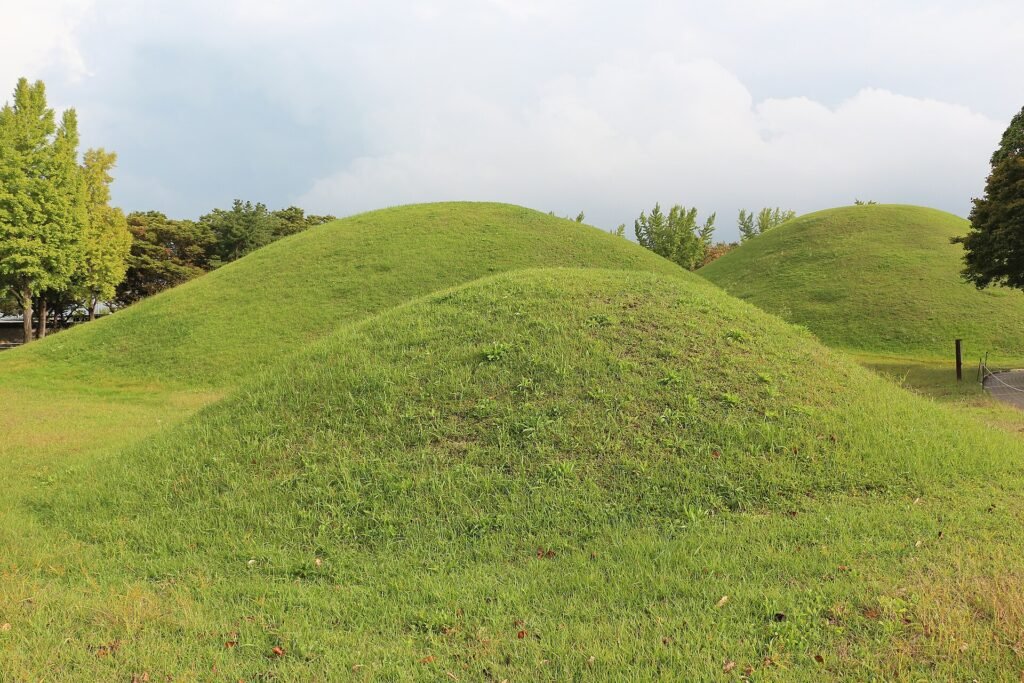
Photo: Daereungwon Tomb Complex by Bernard Gagnon, CC0, via Wikimedia Commons
Gyeongju is called the “museum without walls.” What that means in practice: you’ll be driving past a 1,500-year-old royal burial mound on your way to a convenience store. Let me help you make sense of that in a single day.
I took my wife to Gyeongju for our wedding anniversary several years ago. We had one full day. I’d been once before as a child on a school trip — the mandatory Korean experience of standing in front of Bulguksa Temple being told its historical significance without the context to appreciate it. The adult visit was different.
With one day, a car, and the knowledge of what to prioritize, Gyeongju showed me something I find genuinely difficult to describe: the feeling of being in a place where history isn’t behind a rope barrier in a climate-controlled room, but sitting in an open field for anyone to walk up to and touch. The burial mounds in the center of the city are not fenced off. You walk between them. Families picnic on the grass at their base. Children run around the perimeter. Ancient royal tombs as public park — that’s Gyeongju. This is how I’d spend one day there if I were you.
📋 In This Guide
- Getting to Gyeongju from Seoul: Your Real Options
- My Honest One-Day Itinerary
- Bulguksa Temple: What to Actually Look At
- Where to Eat: My Personal Picks
- Tips Nobody Tells You
Getting to Gyeongju from Seoul: Your Real Options
I’ve done Gyeongju in one day twice. The second time I skipped Bulguksa and spent three hours at Tumuli Park instead. Walking among the royal tombs at dusk is the version I actually recommend.
Gyeongju is approximately 370 kilometers southeast of Seoul. The fastest option is KTX from Seoul Station to Singyeongju Station, taking approximately 2 hours and costing ₩40,000–₩55,000 one-way. Note the station name carefully: Singyeongju Station is the KTX station, located about 15 kilometers west of the city center and the major sites. From Singyeongju Station, you need a taxi (approximately ₩20,000–₩25,000) or the shuttle bus (₩1,400, takes about 30 minutes) to reach the main sightseeing areas. The old Gyeongju Station in the city center is served by slower trains from Daegu — useful if you’re already in that region.
For a one-day trip from Seoul, the KTX is the only practical option — earlier is better. I recommend the 6:30 AM or 7:00 AM KTX from Seoul Station, arriving at Singyeongju around 8:30–9:00 AM. This gives you a full day on the ground before needing to head back. Return trains in the evening fill quickly on weekends and holidays — book your return ticket at the same time as your outbound when possible.
Alternatively: an express bus from Seoul’s Gangnam Express Bus Terminal takes about 3.5–4 hours to Gyeongju Bus Terminal, which is actually in the city center and requires no additional transit — cheaper but slower. If you’re visiting from Busan (approximately 1 hour by local train or 1.5 hours by bus), Gyeongju is an excellent day trip without the Seoul timing pressure.
💡 My Personal Experience: On the anniversary trip, we rented a car at Singyeongju Station. Gyeongju’s sites are spread across a relatively large area and the public transportation connections between them are slow. Having a car transformed the day — we could stop spontaneously at burial mounds we saw from the road, arrive at Bulguksa before the tour buses, and reach Anapji Pond at exactly the right time (late afternoon, before the evening light show crowd). If you’re comfortable with Korean roads and have an international driving permit, renting a car at Singyeongju for the day costs approximately ₩60,000–₩80,000 for a compact vehicle and is money genuinely well spent for a one-day trip.
My Honest One-Day Itinerary
This is based on arriving at Singyeongju around 9 AM and leaving by 7–8 PM. It is achievable and doesn’t feel rushed if you don’t linger excessively at any single site.
9:00–9:30 AM — Daereungwon Tumuli Park (대릉원): The burial mound complex in the center of Gyeongju city. Start here. In the morning light, the grass-covered mounds have a quality that photographs badly and feels extraordinary in person — low, rounded, enormous, scattered across the landscape like something dropped rather than built. Cheonmachong Tomb (천마총) inside the complex is open for interior access (₩3,000 entry). Walking inside a 1,500-year-old royal burial chamber, looking at the artifacts in their original context, is not an experience many historical sites can offer. Take this opportunity. The park surrounding the mounds is free to wander; the enclosed tomb complex has a small entry fee.
10:00–11:30 AM — Bulguksa Temple (불국사): About 16 kilometers southeast of the city center, best reached by taxi or car (approximately ₩15,000 by taxi). UNESCO World Heritage Site. Built in 751 AD during the Silla Dynasty, Bulguksa is considered one of the finest surviving examples of Korean Buddhist architecture.
The specific things to look at: the two stone staircases (Cheongungyo and Baegungyo) leading to the Jahamun gate — they are among the most photographed images in Korean heritage photography for good reason; the Dabotap and Seokgatap stone pagodas in the main courtyard, which represent two different approaches to Buddhist symbolic architecture; and the main hall (Daeungjeon), which contains three gilded Buddha figures that demonstrate the sculptural excellence of the Silla period. The site is large enough that arriving at 10 AM means you’ll be there before most of the tour groups. Leave by 11:30.
12:00–1:00 PM — Seokguram Grotto (석굴암): A twenty-minute uphill drive from Bulguksa (or a 3 km walk uphill). UNESCO World Heritage Site. An artificial granite grotto housing a seated stone Buddha regarded as one of the masterpieces of Buddhist art in East Asia. The preservation challenges mean that you view the main figure through glass — this disappoints some visitors who expected direct access — but the quality of the sculpture and the mountain setting make the visit worthwhile. The walk between Bulguksa and Seokguram through the forest is genuinely beautiful and takes about one hour each way if you want to do it on foot.
1:30–2:30 PM — Lunch in Gyeongju City Center: See food recommendations below. Return to the city center for lunch. This is also the time to walk through the area near Cheomseongdae observatory if you haven’t already — the 7th-century astronomical tower is small but set in an open field that’s pleasant to walk through.
3:00–5:00 PM — National Museum of Gyeongju (국립경주박물관): Free admission. Houses approximately 30,000 artifacts from the Silla Dynasty including the Emille Bell (성덕대왕신종), the largest bronze bell in Korea, cast in 771 AD. The museum is well-curated and has English labeling throughout. This is where the objects that were removed from the burial mounds for preservation live — the gold crowns, the jewelry, the bronze vessels. Seeing the artifacts after walking around the burial mounds in the morning connects the physical experience to the cultural context.
5:30–7:00 PM — Anapji Pond (동궁과 월지) and return: A restored royal pond and garden complex from the Silla period. Beautiful at any time of day but genuinely exceptional at dusk and in the early evening when the lighting of the reconstructed pavilions reflects in the water. Arrive around 5:30 PM to catch the late afternoon light and stay for the evening reflection. After Anapji, head back to Singyeongju Station for your return KTX.
Bulguksa Temple: What to Actually Look At
Most visitors to Bulguksa spend their time at the main hall and take photos of the famous staircase approach. The things that reward more careful attention: the ceiling paintings inside the main hall (Daeungjeon), which are original and show the extent of the original decorative program; the Geuknakjeon hall on the right side of the complex, which is quieter and contains a Buddha figure in a different style; and the stone pagodas in the courtyard, which were the subject of a major restoration controversy in the 20th century.
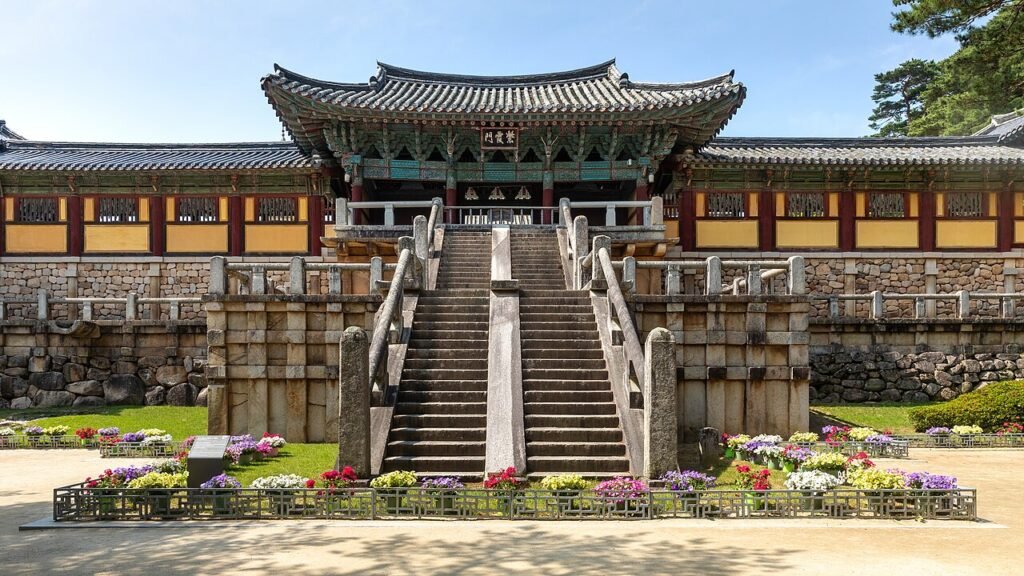
The Dabotap (多寶塔) pagoda in particular is technically remarkable — its incorporation of abstracted lotus motifs and its multi-level construction are unusual in Korean pagoda design and worth examining closely rather than photographing from the standard angle.
Where to Eat: My Personal Picks
Gyeongju has its own local specialties that are worth seeking. Ssambap (쌈밥): Wrapping rice and various condiments in leafy vegetables — particularly popular in the Gyeongju region. Restaurants serving ssambap are common in the downtown area near Daereungwon. Gyeongju bread (경주빵): A local specialty — red bean-filled baked bread shaped like the Dabotap pagoda.
Available at bakeries throughout the city and a good snack for between sites. Every souvenir shop also sells packaged versions, but the fresh-baked versions near the main sites are significantly better. Hwangnam bread (황남빵): The older and more famous version of the local bean-filled bread. The original Hwangnam bakery has been operating since 1939 and is within walking distance of Daereungwon. The queue is usually short in the morning.
Tips Nobody Tells You
The Gyeongju sites are spread across the city and its outskirts — plan your route to minimize backtracking. The order I’ve given above (Daereungwon → Bulguksa → Seokguram → City Center → Museum → Anapji) is geographically logical. Budget under ₩10,000 for entry fees — Bulguksa, Seokguram and Daereungwon have been free since May 2023, while Cheonmachong and Donggung & Wolji charge ₩3,000 each. Most major sites accept international cards; street food and small vendors are cash-only.
The Gyeongju National Museum is open every day except January 1, Seollal and Chuseok — check the official site for current hours. Spring (April–May) and autumn (October) are the most beautiful seasons; summer is hot and humid, though less crowded than the popular seasons. If you have a second day, add Yangdong Folk Village (양동마을, UNESCO Heritage Site) for a living traditional village experience, and Namsan Mountain for a hiking route that passes dozens of outdoor Buddhist carvings on the rock faces — one of the most unusual heritage experiences in Korea.
| Site | Time Needed | Entry Fee | My Priority |
|---|---|---|---|
| Daereungwon (burial mounds) | 60–90 min | ₩3,000 | ⭐⭐⭐⭐⭐ Must |
| Bulguksa Temple | 60–90 min | ₩6,000 | ⭐⭐⭐⭐⭐ Must |
| Seokguram Grotto | 30–60 min | ₩6,000 | ⭐⭐⭐⭐ High |
| National Museum | 90–120 min | Free | ⭐⭐⭐⭐⭐ Must |
| Anapji Pond | 45–60 min | ₩3,000 | ⭐⭐⭐⭐⭐ (at dusk) |
Things Readers Often Ask
Is Gyeongju worth visiting as a day trip from Seoul?
Yes, but only if you take an early KTX (depart Seoul by 7 AM). The round trip takes approximately 4–4.5 hours of total travel time, leaving approximately 8–9 hours on the ground. This is enough for Daereungwon, Bulguksa, Seokguram, the National Museum, and Anapji Pond if you plan the route logically and have transport (taxi or rental car). An overnight stay allows for a more relaxed experience and access to Anapji Pond’s evening illuminations and morning calm.
What is Gyeongju most famous for?
Gyeongju was the capital of the Silla Dynasty (57 BCE–935 CE), one of Korea’s three ancient kingdoms, for nearly a thousand years. It’s famous for its extraordinary concentration of Silla-era heritage: royal burial mounds (tumuli) scattered throughout the modern city, Bulguksa Temple and Seokguram Grotto (both UNESCO World Heritage Sites), and one of Asia’s finest collections of Silla artifacts at the Gyeongju National Museum. It is often called Korea’s “open-air museum” due to the density of historical sites within and around the city.
What is the best way to get around Gyeongju?
For a one-day visit, a rental car (₩60,000–₩80,000 at Singyeongju Station) or strategic use of taxis is the most efficient option. Taxis in Gyeongju are plentiful and reasonably priced. The city bus system covers most major sites but requires patience with wait times and complex routing. Bicycle rentals are available in the city center and are suitable for visiting the downtown sites (Daereungwon, Cheomseongdae, Anapji) but not the temple complex at Bulguksa, which is 16 km from the center.
Before You Go
Gyeongju is the trip I recommend most consistently to foreign visitors who’ve already done Seoul and want to understand what Korea is made of underneath the K-pop and street food. What you find there is a civilization of genuine sophistication that flourished for a thousand years, left material evidence of extraordinary quality, and then dissolved into the landscape in a way that Korea hasn’t fully decided how to manage — part museum, part living city, part open park.
The burial mounds in the city center are the image I come back to most. They’re right there, surrounded by daily life, neither roped off nor particularly explained. They just exist, as they have for 1,500 years. That coexistence of ancient and ordinary is as Korean as anything I know. Go see it. Drop a comment with questions or with what you found there.
About the Author: Hellokoreaguide
Korean local, Gyeonggi-do. Took my wife to Gyeongju for our anniversary and stood inside a 1,500-year-old royal tomb. 13+ years in Korea. Dad. Still thinking about the Silla gold crowns. Questions? Get in touch.
📚 You might also like:
For official site opening hours and entry fees, Gyeongju City’s official tourism portal provides current information in English.
