You just landed at Incheon Airport. You’re exhausted, slightly jet-lagged, and you need to get on the subway — fast. The last thing you want is to fumble with coins and paper tickets while a hundred commuters queue behind you.
That’s exactly why every traveler to Korea needs to know how to use the T-Money card before they arrive. It’s Seoul’s all-in-one transit card, and once you have one, getting around the city becomes almost effortless.
In this guide, you’ll learn what the T-Money card is, where to buy it, how to charge it, where you can use it — and a few tricks that most travel guides skip entirely.
What Is the T-Money Card — and Why Do You Need One?
The T-Money card is a rechargeable smart card used across South Korea’s public transportation network. Think of it as Seoul’s version of London’s Oyster card or Tokyo’s Suica — one card, virtually everywhere.
Here’s why it’s essential:
Cheaper fares: T-Money users pay slightly less per subway or bus ride than single-ticket buyers
Seamless transfers: Transfer between subway lines and buses within 30 minutes at a discounted rate
No more ticket queues: Tap and go — no paper ticket fumbling required
Works nationwide: Busan, Daegu, Incheon, and most Korean cities accept T-Money
Without one, you’ll spend a surprising amount of time at ticket machines. With one, you just tap.
Where to Buy a T-Money Card in Seoul
You have several options — and they’re all pretty easy.
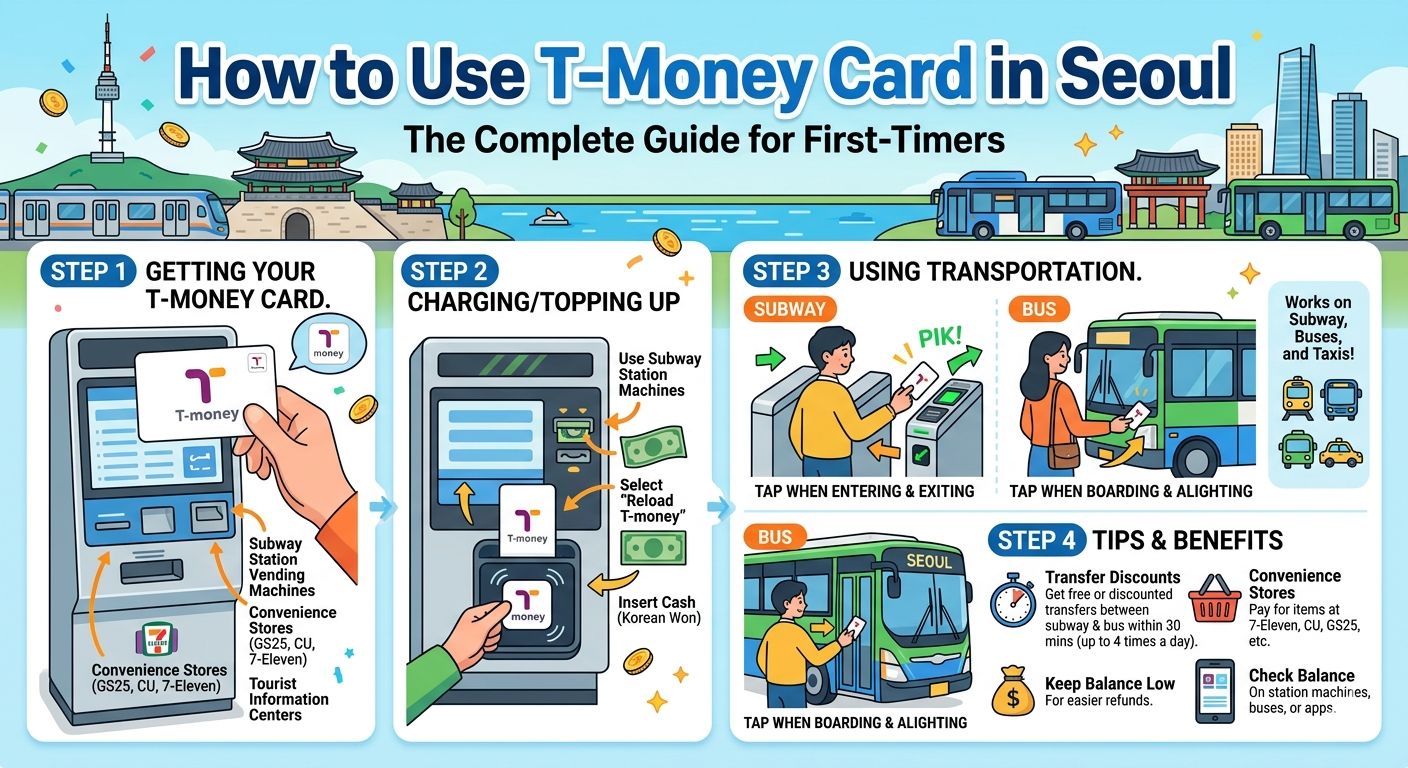
Option 1: Buy at Incheon or Gimpo Airport
The fastest option for most travelers. Look for:
Convenience stores inside the airport (CU, GS25, 7-Eleven) — standard card, ₩4,000–₩5,000
Tourist Information Desks — same price, sometimes with English-speaking staff
Option 2: Buy at Any Convenience Store in Seoul
Once you’re in the city, every CU, GS25, 7-Eleven, Emart24, and Ministop sells T-Money cards. Just ask for “티머니 카드” (T-money card). Price: ₩4,000–₩5,000 for the card itself.
Option 3: Buy Online Before You Leave Home
If you want zero stress on arrival day, order it in advance.
At a convenience store: Hand the card to the cashier and say “충전해 주세요” (chung-jeon hae joo-se-yo — “please charge it”). Tell them the amount. Common top-up amounts: ₩10,000 / ₩20,000 / ₩50,000.
At subway station kiosks: Look for the T-Money logo on the machine. Select English, insert cash, and tap your card on the reader.
Via app: The T-Money Pay app (Android only as of 2026) allows NFC top-ups on compatible Samsung devices.
Minimum recommended balance: Keep at least ₩5,000 on the card at all times. The subway will let you exit with a small negative balance once, but you’ll need to settle it before boarding again.
Where You Can Use the T-Money Card
This is where the T-Money card really shines. It’s accepted far beyond just the subway.
Transportation:
Seoul Metro (all lines)
Seoul city buses (red, blue, green, yellow)
Intercity buses (most routes)
Incheon Airport Railroad (AREX)
KTX and regional trains (selected stations)
Taxis (most Seoul cabs accept T-Money tap payment)
Shopping & Convenience:
CU, GS25, 7-Eleven, Emart24 convenience stores
Some vending machines, parking lots, and public bike rentals (Ttareungyi)
You might be wondering — can I use T-Money for everything? Not quite. Major department stores, restaurants, and most shops don’t accept it. Stick to transit and convenience stores.
Practical Tips for Using T-Money Card in Seoul
Here’s what most first-timers don’t know until it’s too late:
Check your balance before boarding — Tap your card on the yellow reader near the gate to see your balance. No app required.
Always tap OUT on the subway — Tapping only when entering still charges you, but you lose the transfer discount. Always tap both in and out.
The 30-minute transfer window resets — Transfer between bus and subway (or bus to bus) within 30 minutes for a discounted fare (~₩100 off).
Card is refundable — Return it at a subway station service center to get your remaining balance and card deposit back (minus a small processing fee).
Lost your card? T-Money cards are not registered by default — treat it like cash. Some specialty cards (like a named T-Money) allow balance protection.
Compatible with KakaoPay / NaverPay? Some digital wallets now simulate T-Money via NFC — useful if you forget your physical card.
T-Money Card vs Single-Journey Tickets: Which Saves More?
T-Money Card
Single-Journey Ticket
Base subway fare
₩1,400
₩1,500
Bus fare
₩1,300
Not available
Transfer discount
Yes (up to 4 transfers)
No
Refundable
Yes
Deposit only (₩500)
Convenience
Tap & go
Queue at machine
Verdict
Always better for 3+ days
Only for 1-2 rides
The math is simple. If you’re staying for more than a day, the T-Money card pays for itself almost immediately.
Conclusion
Learning how to use the T-Money card in Seoul is genuinely one of the best things you can do before your Korea trip. It’s cheap, widely accepted, saves money on every single ride, and completely eliminates the ticket machine stress.
Get one at the airport the moment you land — or better yet, sort it out before you leave home so it’s one less thing to think about.
Have a T-Money tip we missed? Drop it in the comments — fellow travelers will thank you. And if this guide helped, share it with someone who’s packing for Seoul right now!
목차 [Why Seongsu-dong is Seoul’s #1 Pop-up Destination in 2026 ] [Top 3 Must-Visit Seongsu-dong Pop-up Store Experiences (April 2026) ] [Visitor Info — How to Get to Seongsu-dong ] Looking for the best Seongsu-dong pop-up store experiences in 2026? You’ve found the right guide. Once a quiet factory district, Seongsu-dong has reinvented itself as…
목차 What’s Still Happening: Seoul Spring Festival 2026 Cherry Blossoms Are Over — But Azaleas Are Better Anyway The Seoul Outdoor Library Opens April 23 — Worth Planning Around Best Day Trip Options from Seoul Right Now Practical Tips: Weather, Crowds, and Getting Around Seoul in Spring Frequently Asked Questions Final Thoughts from a Korean…
목차 eSIM vs Physical SIM: Which One Is Right for You? The 3 Korean Networks — SKT, KT, and LG U+ How to Get a SIM Card at Incheon Airport in 2026 Best eSIM Apps for Korea (Tested & Compared) Important Things to Know Before You Buy Frequently Asked Questions Final Thoughts from a Korean…
목차 The Parks: Which One to Choose and Why The Food: Convenience Store Ritual Explained What Koreans Actually Do: Activities and How to Join Best Times and Seasons — Real Talk Practical Tips: What to Bring and What to Skip Frequently Asked Questions Final Thoughts from a Korean Local The Han River is 514 kilometers…
목차 Suwon Hwaseong Fortress: Your Ultimate Day Trip Guide from Seoul Why Visit Suwon Hwaseong Fortress? Exploring Hwaseong Haenggung Palace: A Royal Retreat Haenggung-dong: The Trendiest Neighborhood in Suwon The Best Suwon Night View: Banghasuryujeong How to Get to Suwon from Seoul Frequently Asked Questions (FAQ) Conclusion: Your Next Adventure Awaits References Suwon Hwaseong Fortress:…
목차 The Parks: Which One to Choose and Why The Food: Convenience Store Ritual Explained What Koreans Actually Do: Activities and How to Join Best Times and Seasons — Real Talk Practical Tips: What to Bring and What to Skip Frequently Asked Questions Final Thoughts from a Korean Local The Han River is 514 kilometers…