
Mangwon Market Seoul 2026: Honest Local Food Guide & Tips
If you ask most tourists in Seoul where to experience a real local market, they say Gwangjang or Namdaemun. But ask someone who grew up in Seoul and actually shops at traditional markets every week — my answer is always Mangwon Market (망원시장). This is my honest Mangwon market Seoul food guide, built from dozens of real Saturday mornings spent here with my kids buying groceries, eating hot fishcakes from the stall near the entrance, and watching my daughter demolish a bag of tteok before we even reach the produce section. No tourist pricing. No English menus. Just Seoul.
What Is Mangwon Market Seoul?
Mangwon Market (망원시장) is a traditional covered arcade market in Mapo-gu that has served the neighbourhood for decades. It runs roughly 300 metres through a shaded alley just south of Mangwon Station and sells everything from fresh fish and vegetables to hot street food and dry goods. Unlike Gwangjang — which I love, but which has become increasingly tailored to visitors — Mangwon is still firmly a living market. Grandmothers wheel their trolleys through here. Office workers stop for a quick hotteok on the way to the subway. Families pick up their weekend produce at prices that would make Emart look expensive. If you only visit one market in Seoul that has nothing to do with Instagram, make it this one.
The market is registered with the Korea Tourism Organization as one of Seoul’s key traditional markets, though it flies well under the radar compared to its more famous counterparts.
How to Get to Mangwon Market Seoul
Take Seoul Subway Line 6 (the brown line) to Mangwon Station (망원역) and use Exit 2. Walk straight south for about five minutes — you will see the covered market entrance on your right. The address is roughly 38 Mangwon-ro, Mapo-gu (마포구 망원로 38). The whole journey from central Seoul takes about 20–30 minutes depending on where you start:
- From Hongdae (Hongik University): Take Line 2 to Hapjeong, transfer to Line 6 toward World Cup Stadium, one stop to Mangwon. About 15 minutes.
- From Myeongdong: Take Line 4 to Samgakji, transfer to Line 6 toward Eungam, then ride to Mangwon. About 30 minutes.
- From Yeouido: Take Line 5 or 9 to Yeouinaru, then taxi to Mangwon Market — about ₩5,000 and 8 minutes.
No bus app required. Exit 2, walk five minutes south, look for the covered alley. You will smell the fishcakes before you see the sign.
Best Food to Try: A Complete Mangwon Market Seoul Food Guide
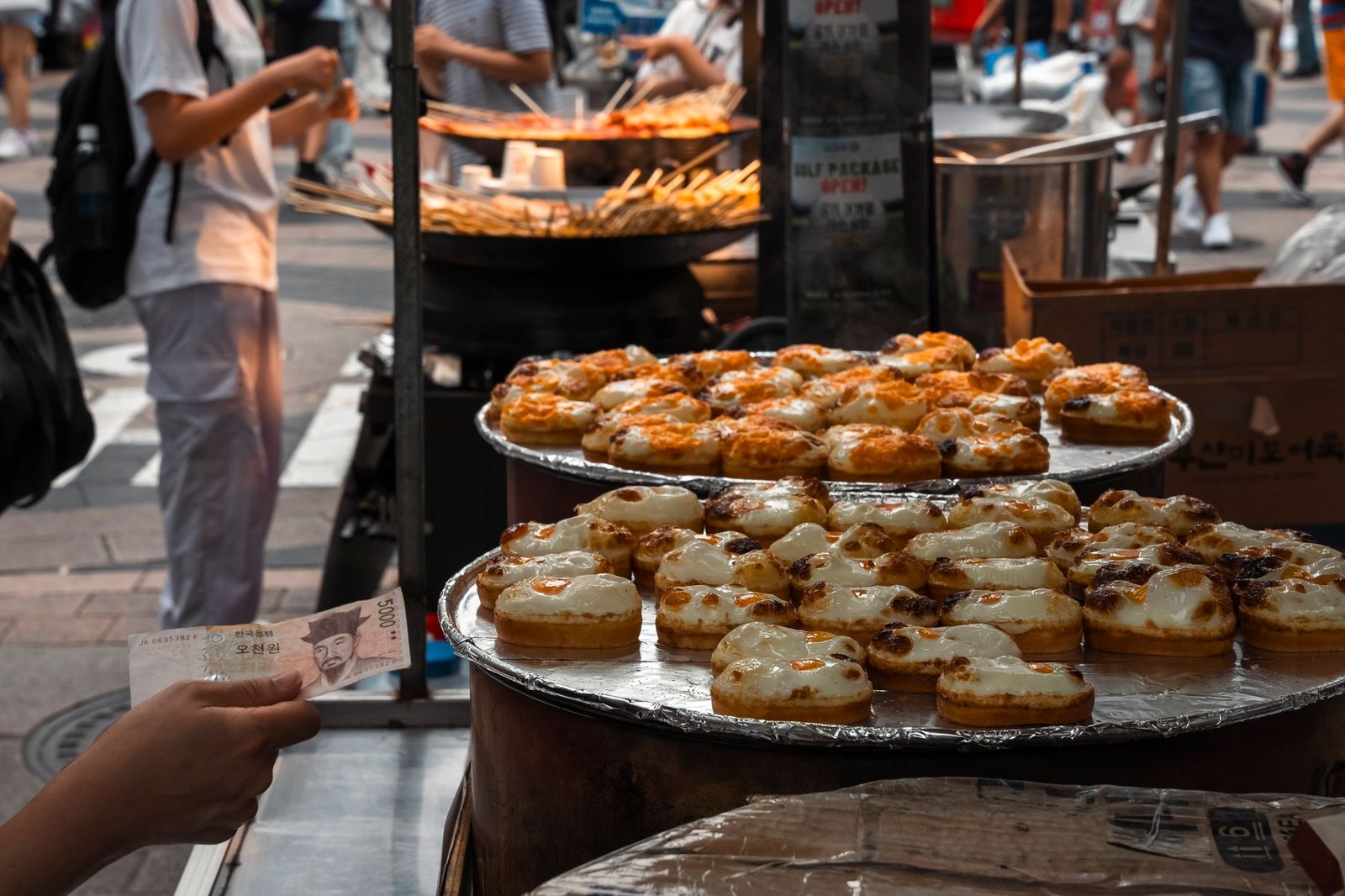
Food stalls line the main alley from both ends. Here is what I personally eat every time I visit, with real prices as of June 2026:
Eomuk (어묵) — Fishcake Skewers: ₩500–₩800 each
The fishcake stalls are usually the first thing you encounter near the main entrance. Skewers float in warm broth and cost ₩500–₩800 each. You can drink the broth for free from a ladle — it is salty and warming, even in summer. My kids eat at least three sticks each before we’ve walked ten metres. Pay after you eat, vendor’s honour system.
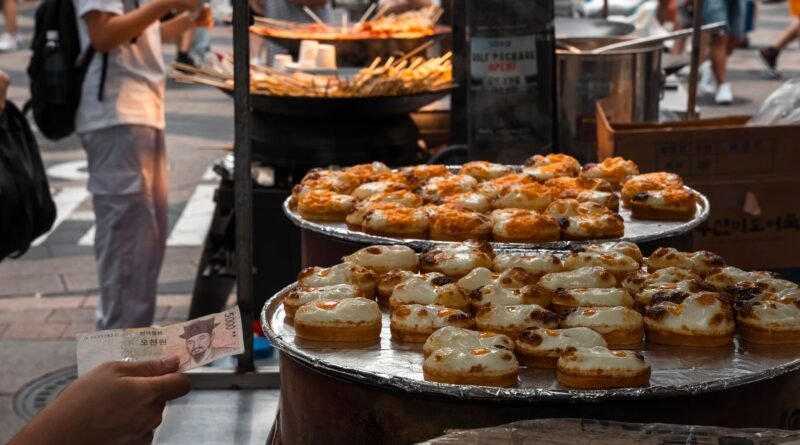
Hotteok (호떡) — Sweet Pancakes: ₩1,000–₩1,500
There is usually one hotteok stall near the middle of the market. The standard version is filled with brown sugar, cinnamon, and chopped peanuts, pressed flat on a griddle until the outside is golden and slightly crisp. A coin of hot sweetness for ₩1,000. Summer variation with seeds and honey runs ₩1,500. Queue if you see one — it moves fast.
Kimbap (김밥): ₩2,000–₩3,500 a roll
Several stalls sell freshly rolled kimbap made that morning. Basic vegetable kimbap is ₩2,000; tuna or beef versions run ₩2,500–₩3,500. This is the real local price — no tourist markup. I often buy two rolls and eat one there, take one for later.
Twigim (튀김) — Fried Snacks: ₩500–₩1,000 per piece
Deep-fried sweet potato, vegetables, and battered squid are piled high at the twigim stall. Point at what you want and hold up fingers for quantity. Fried squid (오징어튀김) at ₩1,000 is my favourite — crispy outside, chewy inside, dusted lightly with salt.
Tteok (떡) — Rice Cakes: from ₩1,500 a portion
Multiple tteok vendors sell pre-packaged traditional rice cakes. In summer you will find surichwi tteok (wormwood green rice cake) and chilled versions like injeolmi rolled in roasted soybean powder. A small pack runs ₩1,500–₩3,000. Excellent for eating later by the Han River.
Summer Fruit: ₩5,000–₩10,000
From June through August the produce stalls pile up with watermelons, peaches, and local plums. A quarter watermelon is ₩5,000–₩8,000 — buy one, ask the vendor to slice it, and carry it to Mangwon Han River Park for an instant picnic upgrade. Fresh peaches go for around ₩5,000–₩7,000 for a bag of five or six.
Fresh Produce and What to Shop For
Beyond street food, Mangwon Market is a real grocery market. Prices run 20–40% lower than major supermarkets for most produce. Here is what gives good value:
- Sesame leaves (깻잎): ₩1,000–₩1,500 a bunch — used in ssam wraps or banchan. Freshness is noticeably better than at a chain supermarket.
- Garlic: ₩3,000–₩5,000 for a full head bag — prices that make sense if you are cooking in a goshiwon or Airbnb.
- Dried seaweed (미역): ₩2,000–₩4,000 depending on grade. Great souvenir if you cook.
- Spices and seasonings: Vendors sell loose gochugaru (chilli flakes), doenjang, and soy sauce at far better prices than convenience stores.
Compared to Gwangjang Market, which I wrote about in my Gwangjang food guide, Mangwon is less glamorous but more honest. No performance cooking for cameras — just vendors who have been here for twenty years doing what they always do.
Local Tips Every Visitor Needs to Know
Cash First, Card Second
Most stalls accept card payment via QR code or card reader, but small food vendors occasionally still prefer cash. Carry ₩20,000–₩30,000 in small bills just in case. There is a GS25 convenience store one minute from Exit 2 with an ATM — if you need cash in a pinch, Korean convenience stores always have 24-hour ATMs that accept foreign cards.
Best Time to Visit
Weekday mornings (9am–11am) are quietest. Saturday between 10am and 1pm is the most lively — all stalls are open, street food is freshest, and you get the full market energy. Avoid arriving after 4pm on any day; vendors start packing up early. Monday is hit-or-miss — some stalls are closed.
No Photography of Vendors Without Permission
This is a working market, not a photo set. If you want to photograph a vendor or their stall, make eye contact, smile, and ask first — a simple gesture pointing at your phone and at them is enough. Most vendors are fine with it once you have bought something. Sticking a camera in someone’s face unprompted is considered rude here.
Bring a Bag
Plastic bags cost extra now under Korean environmental regulations. Vendors will sell you one for ₩100–₩200 if needed, but a reusable tote saves the hassle. I keep a compact bag in my jacket pocket.
Language
Very little English is spoken in this market compared to tourist areas. Numbers work fine — hold up fingers, or use your phone calculator to confirm prices. The vendors are patient and used to curious visitors who clearly do not speak Korean. A kamsahamnida (감사합니다, “thank you”) goes a long way.
Combining Mangwon Market with Han River Park
This is my favourite Seoul summer activity. After shopping at Mangwon Market, walk north along Mangwon-ro for about ten minutes to reach Mangwon Hangang Park (망원한강공원). Buy a quarter watermelon, a roll of kimbap, some tteok, and a few snacks from the market — total cost for two people: ₩15,000–₩25,000. Then spread a mat on the grass, watch the Han River, and have one of the best lunch experiences Seoul offers at a fraction of restaurant prices.
For more ideas on what to bring and where to set up, I covered everything in my Han River picnic guide for foreigners — Mangwon Park and this market are practically designed for each other.
| Info | Details |
|---|---|
| Location | 38 Mangwon-ro, Mapo-gu, Seoul (마포구 망원로 38) |
| Nearest Station | Mangwon Station (망원역), Line 6, Exit 2 |
| Hours | Mon–Sat approx. 9am–7pm (street food from 8am) |
| Best Days | Saturday or Wednesday for full stalls |
| Budget per person | ₩10,000–₩20,000 for food + snacks |
| Payment | Cash preferred; most accept cards |
Frequently Asked Questions
Is Mangwon market Seoul open every day?
Mangwon market is open Monday through Saturday, roughly 9am to 7pm. Saturday has the fullest selection of stalls and the most lively atmosphere. Some stalls close on Monday, so Wednesday or Saturday are the safest days to visit. The market is closed on Sundays and Korean public holidays.
Do I need cash at Mangwon market in Seoul?
Most stalls now accept card payments via QR code or card reader, but a few small food vendors still prefer cash. I recommend carrying ₩20,000–₩30,000 in cash just in case. There is a GS25 convenience store near Mangwon Station Exit 2 with an ATM that accepts foreign cards.
How is Mangwon market different from Gwangjang market?
Gwangjang Market is famous and tourist-friendly, with English menus and prices that have crept up over the years. Mangwon Market is a genuine local daily market where Seoulites do their weekly grocery shopping. Prices are 20–40% lower, there are almost no tourists, and the atmosphere is authentically Korean rather than curated for visitors. Both are worth visiting, but Mangwon feels more real.
