
How to Use T-money Card in Korea 2026: Full Guide
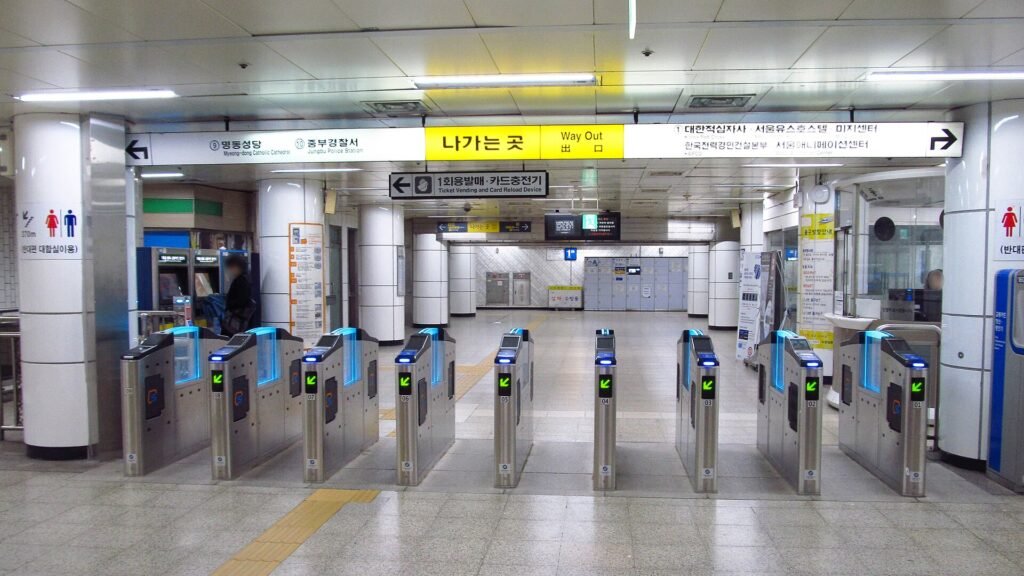
Photo: Seoul-metro-424-Myeongdong-station-gate-20181124-081950 by LERK, CC BY-SA 4.0, via Wikimedia Commons
Update, September 2026: A subway ride starts at ₩1,550 with T-money (₩1,650 with a single-journey ticket) since June 28, 2025. Since March 7, 2026, Seoul Metro adds a base fare to your next trip if you forget to tap out, so always tap out. Sources: Seoul Shinmun, Seoul Shinmun.
Stop fumbling for coins every time you get on a bus. The T-money card is the single best thing you can do on day one in Korea — and it takes about five minutes to set up.
As a Korean dad living just outside Seoul in Gyeonggi-do, I take the bus and subway almost every single day. Whether I’m heading into the city for work or taking my kid to Lotte World on the weekend, the T-money card is in my wallet every single time. I’ve watched so many foreign visitors waste five minutes at turnstiles trying to figure out single-journey tickets when a simple transit card would have solved everything instantly. This guide covers everything — where to buy one, how to charge it, how to actually ride, and a few things people usually learn the hard way. Let’s get into it.
📋 Quick Navigation
What Is a T-money Card and Why You Need One
T-money is a prepaid transportation card that works on virtually all public transit in Korea — Seoul subway lines, city buses, intercity buses, and even most taxis. Think of it like an Oyster Card in London or an Octopus card in Hong Kong, but for Korea. You load money onto it, tap it on a reader when you board, tap again when you get off, and the system automatically calculates your fare and any transfer discounts.
That last part is huge. If you tap your T-money card when you get off one bus and hop onto another within 30 minutes (60 minutes between 9 p.m. and 7 a.m.), you get a free or heavily discounted transfer. With cash or single-journey tickets, you pay full price every single time. A typical one-way subway ride in Seoul costs ₩1,550 (about $1.10), but with smart transfers across a full day of sightseeing, you can easily save ₩3,000–₩5,000 compared to using single tickets. Over a week-long trip, that adds up fast.
Beyond saving money, it’s just faster. No queue at the ticket machine. No scrambling for exact change. Just tap and walk through. That alone is worth it.
Where to Buy Your T-money Card in Korea
Good news — T-money cards are everywhere. The easiest places to grab one are convenience stores: GS25, CU, 7-Eleven, and emart24 all sell them. You’ll find these stores literally inside most major subway stations and on almost every city block. Just walk up to the counter and say “T-money card juseyo” (T-money 카드 주세요) and they’ll hand you one.
The card itself costs about ₩2,500–₩4,000 (roughly $2–3) — that’s a one-time fee for the card, not a deposit. There’s no money loaded on it yet when you buy it. You’ll need to top it up separately (more on that in the next section).
If you want something a bit more fun, you can also find themed T-money cards — things like BTS versions, Kakao Friends characters, or Seoul city-themed designs. These are usually sold at tourist spots, specific convenience store chains, or online retailers like Coupang if you want to order ahead. They typically cost ₩5,000–₩8,000 but work exactly the same way.
One pro tip from me as a Korean dad living in the Gyeonggi-do suburbs: if you’re landing at Incheon Airport, there’s a T-money card kiosk right in the arrivals hall. Buy one before you even leave the airport — you’ll need it immediately for the Airport Railroad (AREX).
💡 Hellokoreaguide’s Tip:
Buy your T-money card at the convenience store inside Incheon Airport Arrivals (1st floor). Load at least ₩20,000 right away. That covers your AREX ride into Seoul (roughly ₩5,000 to Seoul Station on the all-stop train; the ₩13,000 Express train needs its own ticket) plus a few days of casual transit before you need to top up again.
How to Charge (Top Up) Your T-money Card
Charging your T-money card is almost as easy as buying one. Here are all the ways you can do it:
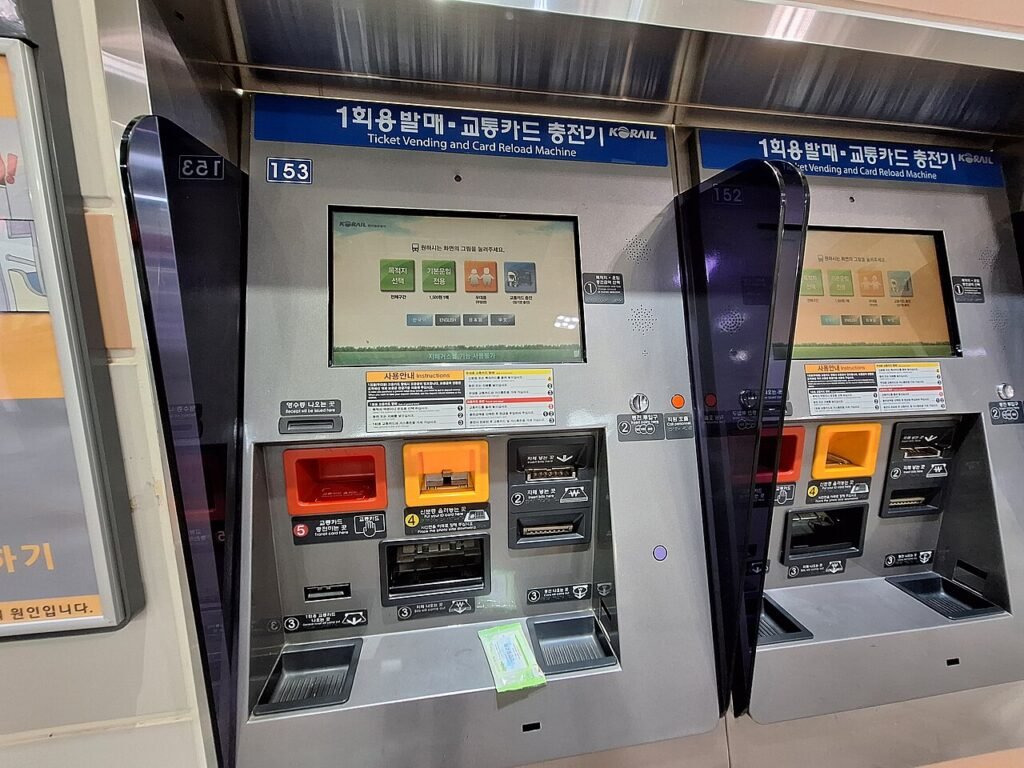
At a convenience store counter: This is the most common method. Hand your card to the cashier, tell them how much you want to add (“icheon won chungjeonssikyeo juseyo” = ₩20,000 please), and pay in cash (T-money top-ups are cash only). Done in 20 seconds. Minimum top-up is usually ₩1,000; most people add ₩10,000 or ₩20,000 at a time.
At subway station kiosks: Every Seoul Metro station has T-money charging machines near the fare gates. Look for the orange machines with a T-money logo. Insert cash, place your card on the reader, and select your amount. They take Korean won notes only (no cards), so carry some ₩1,000 and ₩5,000 notes.
T-money app (for Korean phone users): If you have a Korean SIM and a Korean bank account, you can link the T-money app and charge via mobile. Realistically, most short-term visitors won’t use this route.
The card holds a maximum of ₩500,000 (around $365), though for most tourists ₩30,000–₩50,000 is more than enough for a week of daily transit.
How to Use T-money on Buses, Subways, and Taxis
Using the card itself is very simple — tap on, tap off — but there are a few things to know for each transit type.
Subway: Tap your card on the yellow card reader at the entry turnstile. You’ll hear a beep and see your remaining balance on the screen. When you exit at your destination, tap again on the reader at the exit turnstile. The system calculates the distance-based fare and deducts it automatically.
City bus: Tap when you board (front door reader). Tap again when you exit (middle or rear door reader). This is important — if you don’t tap off, you won’t get your transfer discount, and you’ll be overcharged next time. I see tourists skip the exit tap all the time. Don’t be that person.
Taxi: Most regular taxis and all Kakao Taxi drivers accept T-money. Just tell the driver at the end of your ride that you’ll pay by T-money, and tap your card on the reader on the back of the front seat. Easy.
⚠️ Watch Out:
Always tap OFF the bus when you exit. Forgetting to do this cancels your transfer discount for the next 30 minutes AND adds a penalty distance charge to your fare. It happens to everyone at least once — now you know ahead of time.
T-money Card vs. Single-Journey Ticket vs. Cash: Quick Comparison
| Feature | T-money Card | Single-Journey Ticket | Cash (Bus/Taxi) |
|---|---|---|---|
| Basic subway fare (Seoul) | ₩1,500 | ₩1,650 + ₩500 deposit | Not accepted on subway |
| Transfer discount | ✅ Yes (free or reduced) | ❌ No | ❌ No |
| Works on buses | ✅ Yes | ❌ No | ✅ Yes (exact change) |
| Works on taxis | ✅ Most taxis | ❌ No | ✅ Yes |
| Setup time | 5 minutes | Per-trip queue | Need exact coins |
| Gyeonggi-do buses | ✅ Yes | ❌ No | ✅ Limited |
T-money Tips, Refunds, and Mistakes to Avoid
After years of daily use as a Korean dad living in Gyeonggi-do, here are the real-world things I wish someone had told me earlier — or that I tell foreign friends when they visit.
Check your balance before long trips. The reader shows your balance when you tap in, but if it’s below the base fare (₩1,550), the gate won’t let you in. You’ll need to add funds before you can exit. Awkward. Keep at least ₩5,000 on the card as a buffer.
Refunds are possible. If you’re leaving Korea with money still on your T-money card, you can get a refund at any GS25 or CU convenience store. There’s a ₩500 processing fee — and they’ll deduct that from the total. Convenience stores refund balances up to ₩20,000; for larger amounts, go to a subway station service centre.
One card per person. Don’t try to tap two people through on one card. The system charges per person per tap, and trying to swipe one card twice quickly doesn’t work — the reader locks for about 10 seconds between taps.
Works across Gyeonggi-do and most of Korea. T-money isn’t just Seoul. It works on Incheon buses, Gyeonggi-do provincial buses, and on subways and buses in most other Korean cities. It’s truly a national card.
Frequently Asked Questions About T-money Card Korea
Can I use T-money card at convenience stores to buy things?
Yes! T-money cards work as a payment method at many convenience store chains including GS25, CU, and 7-Eleven — the same stores that sell and charge the card. You can pay for snacks, drinks, and small items by tapping your T-money card at the register. Just make sure you have enough balance, since the transit and retail balance are shared. Note that not every retailer accepts it, but convenience stores almost universally do.
What happens if my T-money card runs out of money mid-ride?
If your balance runs short during a subway ride, the exit gate won’t open — top up at the fare adjustment machine (정산기) next to the gates, then tap out. However, the gate will alert you with a different sound and the screen will show a negative balance. You’ll need to top up the card before you can tap in again for your next journey. On buses, if your card has insufficient funds, the driver may ask you to pay cash instead, so always keep at least ₩2,000–₩3,000 on the card as a safety buffer.
Is there a T-money card app for tourists visiting Korea?
There is an official T-money app, but it’s primarily designed for users with Korean phone numbers and Korean bank accounts, which makes it difficult for most short-term tourists to use for charging. iPhone users have one more option: since spring 2026 you can add T-money to Apple Wallet through the MobileTmoney app and top it up with some foreign cards (Mastercard works; Visa isn’t supported in the app yet). For most foreign visitors, the easiest approach remains buying a physical card at a convenience store or airport kiosk and charging it with cash at convenience store counters. Some convenience stores in tourist-heavy areas now accept foreign Visa/Mastercard for T-money top-ups at the counter.
Ready to Tap and Go?
The T-money card really is one of those things that makes daily life in Korea click into place. As a Korean dad living just outside Seoul, I genuinely can’t imagine navigating the city without one — and I’ve been using it for over a decade. For visitors, it transforms what can be a confusing transit system into something smooth and satisfying. Buy it at the airport, load ₩20,000–₩30,000, and remember to always tap off the bus. That’s honestly 90% of what you need to know.
Have questions about specific routes, or have a T-money story from your own trip to Korea? Drop it in the comments below — I read every single one and I’m happy to help you figure out the best way to get around.
