
Korean Hair Care Routine 2026: Best Complete Honest Guide
When people talk about K-beauty, the conversation almost always starts and ends with skincare. But spend five minutes on Korean social media in 2026 and you will immediately see that the Korean hair care routine has become the next big obsession — and for good reason. I am a parent living in the Seoul-Gyeonggi area, and I have watched my daughter, my coworkers, and my weekend hiking group all develop genuinely elaborate hair care routines over the past two years. The shift is real, and foreigners are just now catching on. Let me walk you through how it actually works.
📋 In This Guide
Why Koreans Take Hair Care So Seriously
My wife’s hair care routine costs more per month than my entire grooming budget. Two things I can confirm actually work from watching her: consistent scalp care and a weekly deep conditioning treatment.
In Korea, your hair is considered a direct reflection of your health and how much effort you put into yourself. This is not vanity in the superficial sense — it is closer to how Koreans think about diet or sleep. Chemists and dermatologists in Korea treat the scalp the same way they treat facial skin: as something that requires active maintenance, not just washing with shampoo.
Korean dermatology clinics have long offered scalp care treatments alongside skin treatments. The idea that scalp health drives hair quality — density, shine, and growth — is simply mainstream medical thinking here, not a fringe wellness trend. What is new is that these clinical approaches have now been packaged into consumer products that anyone can use at home, and the results have been spreading through word of mouth and social media at a remarkable pace.
The Full Korean Hair Care Routine Step by Step
The classic Korean hair care routine follows a sequence that will feel familiar if you know anything about Korean skincare — layering lighter products before heavier ones, and treating the scalp and lengths as separate concerns. Here is the standard approach.
Step 1 — Pre-Shampoo Scalp Scrub (1-2x weekly)
Apply a scalp scrub or exfoliant to dry or damp hair before shampooing. Work it into the scalp in circular motions for 2-3 minutes, then rinse. This removes product buildup, dead skin cells, and excess sebum that regular shampoo cannot clear. Popular formats include gel scrubs with salicylic acid and physical scrubs with fine sugar or sea salt.
Step 2 — Scalp Shampoo
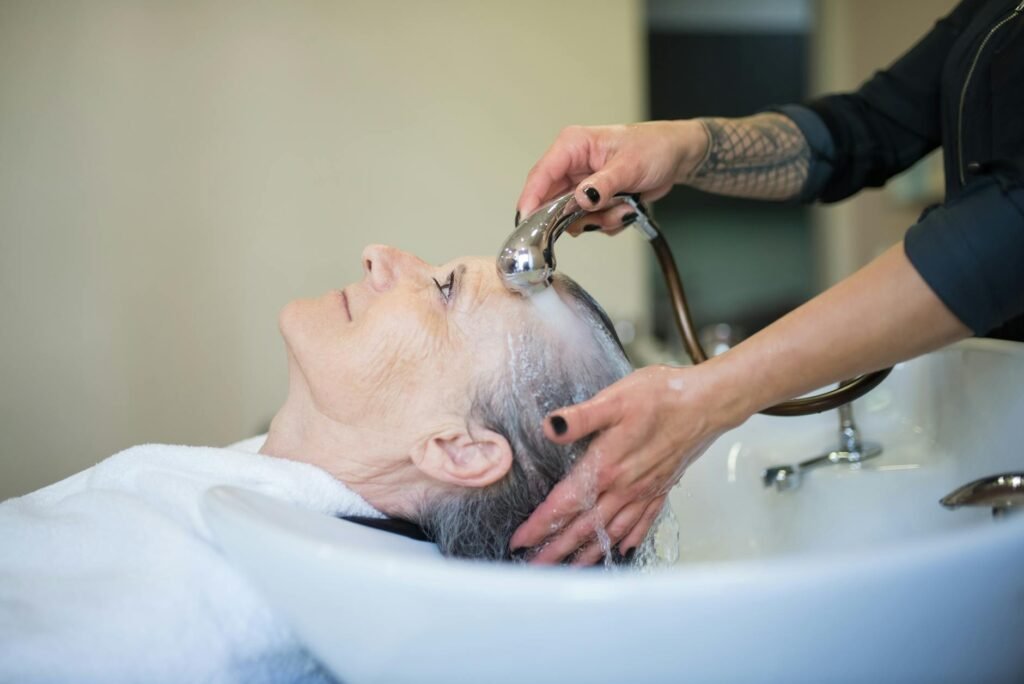
Korean scalp shampoos are formulated with a lower pH than Western shampoos (closer to 5.5), which preserves the scalp’s natural acid mantle. Look for ingredients like centella asiatica, green tea extract, or biotin. Lather at the scalp rather than the lengths — the lengths get cleaned from the rinse water alone.
Step 3 — Hair Mask or Treatment Conditioner
Apply a hair mask from mid-length to ends while the scalp shampoo is still rinsing out. Leave for 3-5 minutes. Korean hair masks tend to be higher in ceramides and panthenol compared to Western equivalents, and the textures are lighter — less greasy, more absorbed.
Step 4 — Scalp Tonic or Ampoule (after drying)
This is the step that surprises most foreigners. After towel-drying, apply a leave-in scalp tonic directly to the scalp using an applicator tip. These tonics contain peptides, niacinamide, or plant stem cells to stimulate follicle health. The concept is borrowed directly from serum application in facial skincare. You do not rinse it out.
Step 5 — Hair Essence or Oil (optional)
A small amount of hair essence applied to damp lengths before blow-drying. Korean hair essences are water-based and incredibly lightweight — a world away from the heavy serums that leave hair looking greasy. They smooth the cuticle and add shine without weighting the hair down.
Best Korean Hair Care Products in 2026
These are products that have genuinely circulated through Korean online communities this year, not curated lists from PR packages.
- RYO Damage Care & Nourishing Shampoo — One of the most-recommended scalp shampoos in Korea. The camellia oil formula addresses moisture without heaviness. Widely available at Olive Young.
- Mise en Scene Perfect Repair Serum — The original Korean hair serum. Extremely lightweight, brilliant shine. A staple in virtually every Korean woman’s bathroom cabinet.
- Dr.FORHAIR Folligen Tonic — The gold standard scalp tonic. Peptide and biotin formula.
- MASIL 8 Seconds Salon Hair Mask — The fast-treatment format (works in 8 seconds, though most people leave it 3-5 minutes) that has become a bestseller at Olive Young and on K-beauty export sites.
- Lador TripleX3 Natural Shampoo — A gentler pH-balanced option popular with sensitive scalp users. Sulphate-free with keratin protein.
Scalp Care — The Step Western Hair Care Routines Ignore
If you take only one idea from this guide, let it be this: treat your scalp the way you treat your face. Everything that happens above the surface — the quality, the density, the shine — is determined by what happens at the follicle level below it.
Koreans typically visit a scalp care clinic (두피 관리샵, dupi gwanri shop) every 4-6 weeks for a professional analysis. These shops use microscope cameras to photograph your scalp and show you exactly what is happening — follicle density, sebum levels, any early inflammation. The analysis genuinely changes how you choose your products. If you are visiting Seoul, a scalp analysis session at a head spa or scalp clinic is easy to find (prices vary widely, so check before you book).
For those continuing their K-beauty journey at home, the Korean approach pairs scalp care with general skin health — the same ingredients that appear in facial toners (niacinamide, centella, adenosine) also appear in premium scalp tonics. Our Korean glass skin routine guide covers the ingredient logic in detail, and much of it transfers directly.
Hair Care Mistakes Koreans Never Make
A few habits that K-beauty experts and Korean dermatologists consistently call out:
- Washing hair with very hot water. Hot water opens the cuticle, strips natural oils, and dries the scalp. Korean routines finish with a cool or lukewarm rinse.
- Skipping the scalp when conditioning. Actually, Koreans deliberately keep conditioner off the scalp — it clogs follicles. The conditioning step is for mid-lengths and ends only.
- Rubbing hair dry with a towel. The friction damages the cuticle. Koreans either pat-dry or use a microfibre towel and let it absorb without rubbing.
- Blow-drying wet hair immediately on high heat. The rule is to air-dry until about 70-80% dry before using a dryer on medium heat with a concentrator nozzle directed downward along the hair shaft.
- Skipping the scalp tonic on days between washes. For people washing every other day or less, the scalp tonic is applied on non-wash days as a maintenance step.
For building out your full Korean beauty toolkit for a trip to Seoul, the Korean sunscreen 2026 guide is the essential companion for outdoor sightseeing days when UV exposure also affects scalp health directly.
Where to Buy Korean Hair Care Products
Inside Korea, Olive Young is the primary destination — it is the Korean equivalent of Sephora and stocks essentially everything on this list. Larger branches in Hongdae, Myeongdong, and COEX have dedicated hair care sections with trained staff. Prices are cheaper than export sites, and there are almost always multi-buy promotions running.
For buying outside Korea, YesStyle, StyleKorean, and Jolse are the most reliable export retailers with authentic stock. Be cautious with Amazon listings for Korean brands — counterfeit products exist, particularly for popular serums like Mise en Scene.
If you are visiting Seoul and want expert guidance beyond what you can find online, the Korea Tourism Organization has a K-beauty shopping district guide covering Myeongdong, Hongdae, and Insadong that is regularly updated.
The bottom line from someone who has watched this trend develop from the inside: the Korean hair care routine works because it treats the scalp as living skin rather than a surface to clean. Start with the scalp shampoo and one leave-in tonic, and build from there. You will see the difference within four to six weeks.
Common Questions
How is a Korean hair care routine different from regular hair care?
A Korean hair care routine treats scalp health as the foundation of everything — using dedicated scalp shampoos, exfoliants, and leave-in tonics before addressing the hair lengths. The most distinctive element is the post-wash scalp ampoule or tonic, a leave-in treatment applied directly to the scalp that Western routines typically skip entirely. The overall philosophy mirrors Korean skincare: layer lightweight products, target the root cause (follicle health), and maintain consistency over intensity.
How often should I do the full Korean hair care routine?
The pre-shampoo scalp scrub is done once or twice per week. The shampoo and conditioner steps happen every 2-3 days for most hair types, though daily washing is common in Korea due to the humid climate and pollution. The scalp tonic is applied every day, including on non-wash days. The hair mask replaces the regular conditioner once or twice a week for extra treatment.
Which Korean hair care brand is best for beginners to start with?
RYO and Lador are the two most recommended Korean hair care brands for beginners. RYO is widely available both in Korea and internationally and covers the full routine from shampoo to tonic. Lador is slightly more accessible in terms of price and offers a clean, gentle formulation that works for most hair and scalp types. Both brands are sold at Olive Young stores throughout Korea and on major K-beauty export websites.
