
How to Eat Naengmyeon in Seoul 2026: A Local’s Honest Guide
Every summer in Korea, one dish reclaims its throne more reliably than any other: naengmyeon. If you have been wondering how to eat naengmyeon in Seoul without embarrassing yourself — when to add vinegar, how much mustard is too much, why the server is reaching for scissors — this guide is everything I wish someone had handed me when I first brought a foreign colleague to my favorite Mapo-gu shop and watched him pour the entire mustard dispenser into his bowl.
I am a Seoul local. I grew up in the Gyeonggi area, I work long hours in the chemical industry, and I have eaten naengmyeon at least once a week every July and August for the past 30 years. My father introduced me to it after Sunday hikes. Now I take my own kids. The dish has not changed. Only the prices have.
What Is Naengmyeon? Korea’s Most Essential Summer Dish
Naengmyeon (냉면) means “cold noodles” in Korean. The dish traces its roots to the Pyongyang and Hamhung regions of what is now North Korea, which is why respected Seoul shops still advertise themselves as 평양냉면 (Pyongyang naengmyeon) specialists — a pedigree that carries genuine status here.
The noodles are thin, dark, and intensely chewy. Depending on the style, they are made from buckwheat (메밀, memil) or sweet potato starch (고구마 전분). They arrive ice-cold — sometimes literally with shaved ice floating in the broth — and the entire experience is engineered to cool you down when the Korean summer humidity makes hot food feel impossible.
Naengmyeon is not a trendy food. It is not Instagram-famous or part of the Hallyu wave. It is the dish that every Korean family has eaten for generations, and it is still the best argument I know for the idea that simplicity, done with obsessive care, is its own form of genius. This makes knowing how to eat naengmyeon in Seoul correctly one of the most rewarding food skills you can develop as a visitor.
Mul Naengmyeon vs Bibim Naengmyeon: Know Before You Sit Down
These are the two main styles you will encounter in Seoul, and ordering the wrong one without knowing the difference is the most common mistake foreigners make.
물냉면 (Mul Naengmyeon) — Pyongyang Style
This is the broth version. The broth is made from slow-simmered beef brisket and fermented radish water (동치미, dongchimi) and served at near-freezing temperature. The flavor is clean, subtle, and slightly sour — almost mineral. There is no spice whatsoever. First-timers are regularly surprised by how restrained it tastes. This is intentional. A great mul naengmyeon broth takes days to make and is the truest test of a shop’s skill.
Standard price: ₩12,000–₩15,000 per bowl at a mid-range restaurant.
비빔냉면 (Bibim Naengmyeon) — Hamhung Style
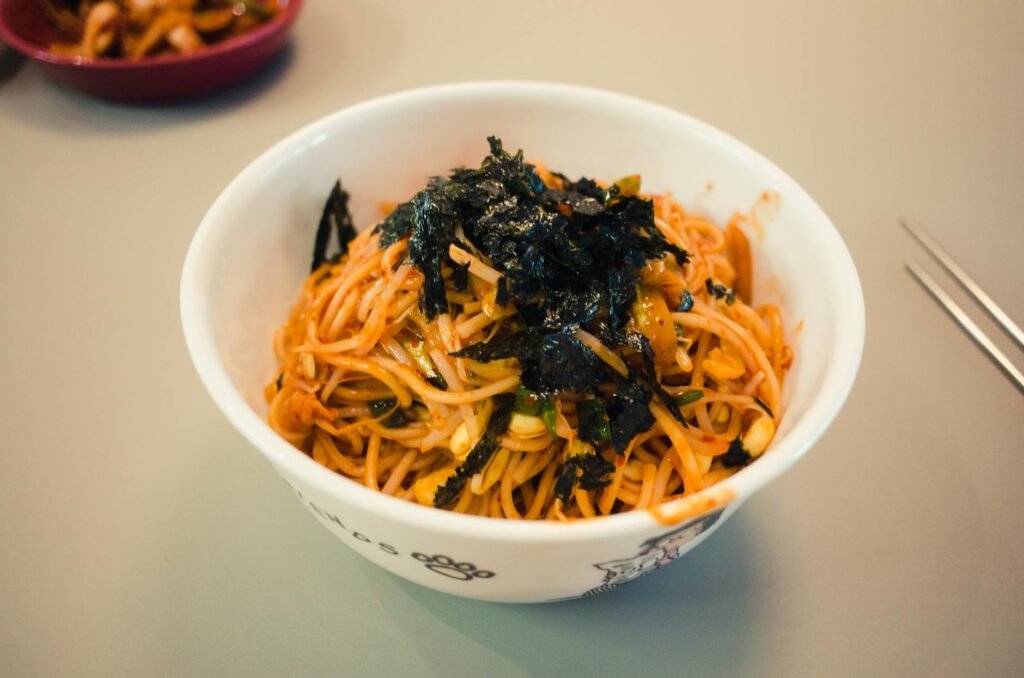
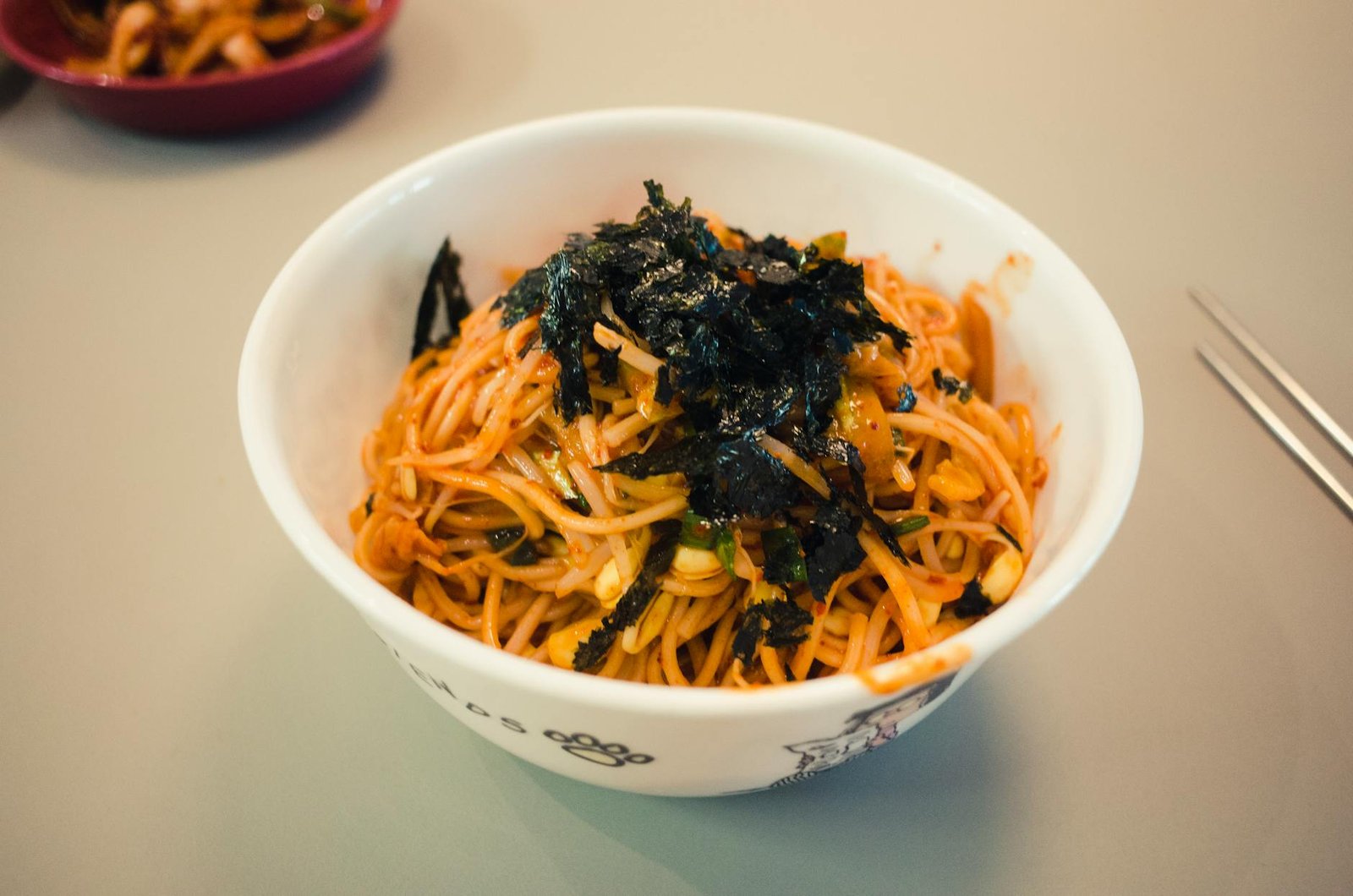
This is the spicy mixed version — no broth, just noodles tossed in a bright red gochujang-based sauce with cucumber, a halved hard-boiled egg, and thin slices of pear or apple for sweetness. The noodles in this style are made from potato starch, making them even chewier and more elastic than the buckwheat version. Spice level is medium — manageable for most people, even those who are not accustomed to Korean food.
Standard price: ₩11,000–₩14,000.
My recommendation for first-timers: Always start with mul naengmyeon. The broth tells you instantly whether the restaurant cares. A kitchen that slow-simmers dongchimi properly cannot hide it, and neither can a kitchen that does not. Bibim is great, but the sauce can mask shortcuts. Mul exposes everything.
While you are exploring Korean food culture, our Gwangjang Market food guide has another angle on eating like a local on a budget.
How to Eat Naengmyeon in Seoul — The Step-by-Step Korean Ritual
Understanding how to eat naengmyeon in Seoul the right way is the difference between a good meal and a great one. Here is the exact sequence every Korean follows:
- Taste the broth first, unaltered. Before touching the vinegar or mustard, take one small sip of the mul naengmyeon broth. This is when you assess quality. A good broth has depth, a gentle tartness from the dongchimi, and a clean finish. If it tastes thin or flat, the kitchen took shortcuts.
- Add vinegar (식초, sikcho) in a small amount. The white vinegar on every table is meant to brighten the broth, not overpower it. I use about one teaspoon. Start with less than you think you need. You can always add more.
- Add Korean mustard (겨자, gyeoja) — just a dab. This is the most dangerous condiment at the table for foreigners. Korean mustard paste is significantly stronger than Western yellow mustard. A small dab the size of a pea is enough. My foreign colleague used an amount the size of a walnut and experienced what he described as “a nasal cleaning”.
- Ask for scissors. Say “잘라 주세요” (jalla juseyo) and the server will cut the noodles with scissors into manageable lengths. In most good restaurants, staff will do this without being asked, but it is perfectly normal to request it. Do not feel awkward.
- Eat slowly and mix as you go. Do not dump everything into the bowl at once. Take a few strands of noodle alone, then combine with toppings and broth. This way you experience each element separately before they meld.
- Drink the remaining broth at the end. This is considered the proper finish to the meal. On a hot Seoul summer day, that final cup of cold, tangy broth is one of the most genuinely refreshing things you can consume.
Pair naengmyeon with a side of tteokbokki at a street food stall nearby for a classic Korean combination that every local knows.
Where to Eat Naengmyeon in Seoul — Real Local Spots
I am not listing viral places tourists already know. I am listing where Koreans actually go.
우래옥 (Woo Lae Ok) — Jung-gu
Open since 1946. The broth is made from beef bones and dongchimi fermented over months. This is the benchmark all other Pyongyang naengmyeon restaurants are judged against. Located near Euljiro 4-ga Station (Lines 2 and 5), 5-minute walk. Price: ₩18,000 per bowl. Expect a queue of 20–40 minutes on weekdays, longer on weekends. The queue moves faster than it looks. Closed Monday.
을지면옥 (Euljiro Myeonok) — Jung-gu
Hidden among old hardware shops in the Euljiro area near Euljiro 3-ga Station (Lines 2 and 3). The broth is richer and slightly thicker than Woo Lae Ok’s — more beefy, less mineral. No English menu. Bring Papago or Google Lens. Price: ₩16,000. Closed Sunday and Monday. This is my second choice and the place I bring colleagues who want something more approachable.
평양면옥 (Pyongyang Myeonok) — Mapo-gu
Near Gongdeok Station (Line 5/6, Exit 1), about a 10-minute walk through residential streets. This is my personal regular — not famous, no tour bus outside, broth unchanged for 20 years. ₩13,000 per bowl. Lunch only: 11:00–15:00. Cash preferred, though they accept cards.
Budget Approach: Any 고깃집 (Korean BBQ Restaurant)
Almost every Korean BBQ restaurant in Seoul serves naengmyeon as a closing dish or a standalone lunch option. Price: ₩9,000–₩11,000. Quality varies, but it is a perfectly valid first encounter with the dish without the intimidation of a famous specialized restaurant. If you want to try Korean BBQ first, our Korean BBQ guide has everything you need before you sit down.
For more destinations recommended by the Korea Tourism Organization, see VisitKorea.or.kr.
Naengmyeon Prices in Seoul 2026 — What Is Realistic?
Prices have risen significantly. The average bowl in Seoul reached ₩12,692 in July 2026, according to the Korea Consumer Agency — a trend Korean media named 냉면플레이션 (naengmyeonflation). This is not a restaurant rip-off. Labor and rent keep getting more expensive, even though buckwheat prices have eased. Here is what to realistically budget:
| Style | Budget / Chain | Standard Restaurant | Famous / Heritage Spots |
|---|---|---|---|
| 물냉면 Mul Naengmyeon | ₩9,000–₩11,000 | ₩12,000–₩15,000 | ₩16,000–₩19,000 |
| 비빔냉면 Bibim Naengmyeon | ₩9,000–₩11,000 | ₩11,000–₩14,000 | ₩15,000–₩18,000 |
Paying ₩18,000 at Woo Lae Ok is not being overcharged — you are paying for a broth made from real beef bone and months of fermentation. Paying ₩9,000 at a BBQ restaurant side dish is also legitimate. Both are correct depending on what you want.
Korean Phrases for Ordering Naengmyeon
You do not need perfect Korean. These six phrases will handle every situation:
- 물냉면 주세요 (mul naengmyeon juseyo) — I’ll have the broth-based cold noodles, please.
- 비빔냉면 주세요 (bibim naengmyeon juseyo) — I’ll have the spicy mixed cold noodles, please.
- 잘라 주세요 (jalla juseyo) — Please cut the noodles [with scissors].
- 식초 더 주세요 (sikcho deo juseyo) — More vinegar, please.
- 겨자 조금만요 (gyeoja jogeumman-yo) — Just a little mustard, please.
- 맵지 않나요? (maepji annayo?) — Is it spicy?
Mistakes Foreigners Almost Always Make
- Adding too much mustard. I have seen this dozens of times. The Korean mustard at naengmyeon tables is far more pungent than anything sold as “mustard” outside Korea. A dab the size of a coin is already bold.
- Eating mul naengmyeon warm. If your bowl has been sitting more than five minutes and the ice has melted, ask for a fresh one. The dish is built around temperature. A warm mul naengmyeon loses its identity entirely.
- Not finishing the broth. Many foreigners leave the broth behind, thinking they have already eaten. The broth is the point. Finish it.
- Confusing serving size with portion size. A single bowl of naengmyeon is a complete meal in Korea. Do not order two bowls each plus a full Korean BBQ spread and expect to walk normally afterward. Trust me on this one.
- Skipping the scissors step. Some foreigners think cutting the noodles is somehow cheating. It is not. The noodles are cut specifically to make eating easier. There is no honor in wrestling a 50-centimeter strand of buckwheat noodle around your chopsticks.
Frequently Asked Questions
Is naengmyeon spicy?
Mul naengmyeon (the broth version) is not spicy at all. It has a clean, cold, slightly sour flavor with no heat. Bibim naengmyeon (the mixed version) is moderately spicy from a gochujang sauce, but most foreigners find it manageable. Always specify which type you want when ordering.
How much does naengmyeon cost in Seoul in 2026?
A standard bowl costs between ₩12,000 and ₩15,000 at a mid-range restaurant in 2026. Budget spots and Korean BBQ restaurants offer it for ₩9,000–₩11,000, while heritage spots like Woo Lae Ok charge ₩16,000–₩19,000 for hand-crafted broth made over several days.
Do I need to speak Korean to order naengmyeon?
No Korean is required at most Seoul naengmyeon restaurants — pointing at a menu or showing a photo works fine. However, knowing three phrases helps enormously: 물냉면 주세요 for the broth version, 비빔냉면 주세요 for the spicy version, and 잘라 주세요 to ask staff to cut your noodles with scissors.
