
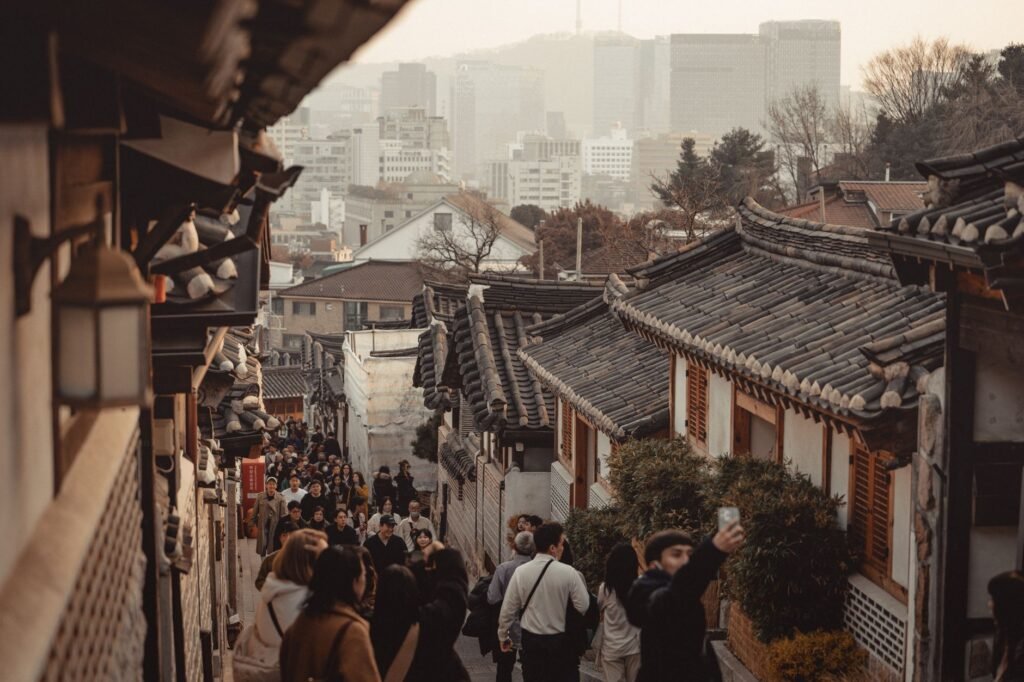
Bukchon Hanok Village 2026 Tourist Rules & Honest Guide
If you are planning to visit Seoul and Bukchon Hanok Village is on your list, please read this first. I live in Seoul’s Gyeonggi area and pass through Bukchon several times a year — watching this neighborhood change has been striking. The complete Bukchon Hanok Village tourist rules 2026 situation is something every foreigner should understand before arriving, because the city now enforces a real curfew with a real ₩100,000 fine. No warning, no grace period. In this guide I will share what I know as a local, including what actually triggers the fine, how to get there, and the unwritten etiquette that makes a difference to the people who actually live on those famous alleys.
Table of Contents
- What Is Bukchon Hanok Village?
- Bukchon Hanok Village Tourist Rules 2026: The Official Zones
- The ₩100,000 Fine — Exactly What Triggers It
- How to Get to Bukchon from Seoul Subway
- Best Spots to Visit and What to Skip
- Photo Etiquette: What Seoul Residents Actually Feel
- Frequently Asked Questions
What Is Bukchon Hanok Village?
Bukchon (북촌) means “north village” in Korean. It sits between Gyeongbokgung Palace to the west and Changdeokgung Palace to the east, covering the Gahoe-dong and Samcheong-dong neighborhoods of Jongno District. The name comes from its position north of the two streams that once ran through Joseon-era Seoul — a location that made it prime real estate for high-ranking officials during the Joseon dynasty (1392–1897).
Today, over 900 hanok buildings still stand here. Some have become guesthouses, artisan studios, or cafes. But many are simply people’s homes — families who have lived in this neighborhood for generations, or new residents who specifically chose a hanok for its architecture and quiet streets. This is the foundation for every rule that follows: Bukchon is a real residential neighborhood, not a theme park.
Korea’s popularity with international tourists has surged in recent years, and Bukchon became one of the most photographed spots in all of Asia. By the early 2020s, the residential alleys were overwhelmed on weekends. Residents reported being unable to sleep past 9 AM, coming home to find strangers photographing their front doors, and having their gates touched and rattled for photos. Seoul city government eventually stepped in.

Bukchon Hanok Village Tourist Rules 2026: The Official Zones
In November 2024, Jongno District (Jongno-gu) formally designated a Special Management Zone within Bukchon, with enforceable visiting restrictions. By 2026 the system is fully operational. Here is what it means in practice:
| Time | Red Zone Access | Notes |
|---|---|---|
| 10:00 AM – 5:00 PM | Open to tourists | Standard visiting window |
| 5:00 PM – 10:00 AM | Restricted | Fine of ₩100,000 applies |
| Sundays (certain zones) | Reduced access | Resident rest day — check Seoul Gov notice |
The Bukchon Guardians — paid city staff — actively patrol the area and will approach tourists who remain in restricted alleys after 5:00 PM. They will ask you to leave. If you do not comply, a fine notice is issued on the spot. The official notice from Seoul Metropolitan Government is available in English here.
Charter buses and organized group tours face even steeper penalties: ₩300,000 for a first offense, rising to ₩400,000 for a second and ₩500,000 for a third. Tour operators who bring large groups outside permitted hours now risk serious consequences.
This is the single most important update in any Bukchon Hanok Village tourist rules 2026 guide you will read. Many older blog posts and travel resources still do not reflect these regulations. Do not rely on pre-2024 information.
The ₩100,000 Fine — Exactly What Triggers It
The ₩100,000 fine applies specifically to the Special Management Zone’s restricted alleys, which includes the most famous viewpoint: Bukchon-ro 11-gil — the narrow stone staircase lined with rooftile-capped walls that you have almost certainly seen in photos. It is about 80 meters long and it looks down toward Insadong and the modern city skyline. This alley is the one that appears in every Seoul Instagram post, every K-drama Seoul montage, every “must-visit Seoul” list.
After 5:00 PM, this alley is off-limits to tourists. But the fine can also apply in other designated Red Zone streets — pick up a paper map from the Bukchon Information Center (located at Anguk Station Exit 3) which clearly marks the restricted zones. Do not guess.
Even during permitted hours, these behaviors can draw official attention or removal requests from Bukchon Guardians:
- Using professional photography equipment (tripods, ring lights, drone cameras) without permission
- Standing in groups of more than four people in the narrow alleys and blocking resident access
- Sitting on residential steps or leaning against gates
- Loud conversations — stone alleys amplify sound significantly
If you are wondering what counts as “professional” equipment: I asked at the information center, and they said tripods are the main indicator. A standard phone or camera is fine; a tripod signals an extended photoshoot in a space residents have to walk through.
How to Get to Bukchon from Seoul Subway
Bukchon Hanok Village is very accessible by Seoul Metro, which is how most visitors — and all locals — get there. Use Naver Map to navigate, as it gives accurate walking routes from subway exits in Korean neighborhoods where addresses can be confusing.
Anguk Station (안국역) — Line 3 (Orange Line), Exit 3
This is the closest station to the heart of Bukchon. From Exit 3, the walk to the start of the village alleys takes about 5 minutes. The Bukchon Information Center is right at this exit — stop here first to pick up a free map that marks the restricted zones.
Gyeongbokgung Station (경복궁역) — Line 3, Exit 2
This exit puts you near the entrance of Gyeongbokgung Palace. From the palace’s east side, it is a 10–12 minute walk into Bukchon’s Gahoe-dong area. Good option if you plan to visit both Gyeongbokgung and Bukchon in the same morning.
My recommendation: arrive no later than 10:30 AM on weekdays, or 10:00 AM sharp on weekends. By 11:00 AM on a Saturday in spring or autumn, the main staircase alley already has a queue. The light for photography is also best in the morning — the alleys face east, which means warm morning sun and harsh afternoon shadow.
Best Spots to Visit and What to Skip
The famous viewpoint on Bukchon-ro 11-gil is worth seeing once. Stand at the top of the staircase, take your photo, and move on — do not linger. You will see others doing extended photoshoots here; understand that this is exactly what frustrated residents enough to push for regulations in the first place.
My personal favorite part of Bukchon is the quieter back streets of Gahoe-dong — the alleys east and north of the main tourist circuit. Very few visitors make it here. The hanok architecture is equally beautiful: original wooden gates, aged clay walls, small neighborhood shrines that are completely unrelated to tourism. You can walk these streets for 20–30 minutes and barely see another tourist.
Samcheong-dong, just north of Bukchon, is excellent for post-walk cafes and galleries. Several hanok buildings have been converted into cafes with traditional courtyard seating. Expect to pay ₩6,500–₩9,000 for specialty coffee — above Seoul’s average, but the setting justifies it. This area also connects naturally to a walk through Gyeongbokgung Palace.
Many of Bukchon’s alleys appeared in major K-dramas — if you are a fan, a visit pairs well with checking our K-drama filming locations guide for the specific streets used in popular shows shot in this neighborhood.
Photo Etiquette: What Seoul Residents Actually Feel
I want to be honest with you here, because I think you deserve more than the polished version.
Many Seoul residents — including people I know — have deeply complicated feelings about Bukchon as a tourist attraction. The neighborhood is genuinely beautiful, and I understand why millions of people want to photograph it. But for the families who live there, every weekend brings hundreds of strangers standing outside their front doors, speaking loudly, pointing cameras at their private spaces. Some residents have reportedly moved out entirely.
The city’s rules address the most egregious behaviors, but there is etiquette that goes beyond what any rule can capture. As someone who cares about representing Korea authentically — and as a parent who understands what it feels like when strangers intrude on your home environment — I would ask for this:
- Walk quietly. Keep conversations at a conversational volume. The narrow stone alleys carry sound in ways you might not expect.
- Never touch gates or walls for a photo. These are someone’s front door.
- If you see a resident, bow slightly and step aside. They should not have to squeeze past your camera.
- Do not photograph into courtyards through open gates — even if the gate is open, it is not an invitation.
For more on Korean cultural expectations around public spaces, our guide to Korean culture rules tourists break covers the broader context of why these things matter to local people.
Frequently Asked Questions
What happens if you visit Bukchon Hanok Village after 5 PM in 2026?
The Red Zone alleys — including the famous Bukchon-ro 11-gil staircase — are restricted to tourists between 5:00 PM and 10:00 AM. Remaining in these areas after 5 PM can result in a fine of ₩100,000, issued by Bukchon Guardians who patrol the neighborhood. Organized tour buses face fines starting at ₩300,000 for violations.
Is Bukchon Hanok Village free to enter in 2026?
Yes, there is no entrance fee to walk through Bukchon Hanok Village. However, the fine for violating restricted-zone curfew hours is ₩100,000, so arriving during the permitted window of 10 AM to 5 PM is essential. Individual hanok cafes and studios inside may charge a separate admission or have a minimum purchase.
What is the best day and time to visit Bukchon Hanok Village?
Weekday mornings — particularly Tuesday through Thursday — are far quieter than weekends. Arrive between 10:00 AM and 11:00 AM to catch the best morning light and fewest crowds at the staircase viewpoint. Avoid public holidays, cherry blossom season (late March to early April), and autumn foliage weekends when crowds are at their peak.
