Korean Jjimjilbang Guide 2026: A Local’s Complete Explainer
📌 This post contains affiliate links. If you book or purchase through our links, we may earn a small commission at no extra cost to you.
Every K-drama fan has seen it. Almost no foreign tourist actually does it. And the ones who finally go always say the same thing: “Why did I wait so long?”
I’ve been going to jjimjilbangs my entire life. As a Korean dad living in Gyeonggi-do, the local jjimjilbang has been my Tuesday night decompression spot, my weekend family outing, and my go-to answer when foreign colleagues ask what uniquely Korean experience they shouldn’t miss. It’s not the palaces. It’s not the street food. It’s this: a ₩12,000 entry into a sprawling bathhouse-sauna-restaurant-sleeping hall complex where Koreans of every age gather to wash, sweat, eat, sleep, and genuinely relax in a way that has no direct equivalent anywhere in the world. If you’re visiting Korea in 2026 and you skip the jjimjilbang because it sounds intimidating, you’ve missed one of the best things the country has to offer. This guide will make sure that doesn’t happen.
📋 What’s Inside
- What Is a Jjimjilbang? The Real Explanation
- Step-by-Step: Exactly What Happens When You Walk In
- The Naked Part: What Foreigners Are Actually Scared Of
- The Best Jjimjilbang Experiences: Sauna Rooms, Eggs & Sikhye
- Best Jjimjilbangs in Seoul 2026 + Practical Tips
What Is a Jjimjilbang? The Real Explanation
I wrote an earlier version of this for a foreign colleague nervous about his first jjimjilbang trip. He came back saying it was the best thing he’d done in Korea. That reaction is extremely common.
The word jjimjilbang (찜질방) breaks down as jjimjil (fomentation — applying heat for therapeutic effect) and bang (room). But a modern jjimjilbang is far more than a heated room. It’s a 24-hour wellness and social complex that typically includes gender-separated naked bathing areas (the mogyoktang, 목욕탕), multiple themed sauna rooms, a large unisex common area with sleeping mats, a snack bar, and often additional amenities like massage rooms, PC rooms, fitness equipment, or rooftop spaces. Entry prices range from ₩7,000 at a small neighborhood bathhouse to ₩20,000 at major upscale facilities. That fee covers unlimited time, a locker, a provided uniform (shorts and t-shirt), and two small towels.
People don’t just pop in for an hour. Koreans regularly spend entire evenings — sometimes entire nights — at a jjimjilbang. The culture around them is deeply social: couples come on dates, entire families come with grandparents and children, work colleagues go after a company dinner, and solo visitors come simply to sleep in the warm common area rather than pay for a hotel. When I was younger, my father would take me to our neighborhood jjimjilbang on winter Saturdays. There’s something about the combination of heat, water, food, and unhurried time that strips away social pretense in a way that few other environments manage. Foreigners who experience it almost universally describe it as one of the highlights of their trip.
💡 Hellokoreaguide’s Tip: There’s an important distinction between a jjimjilbang (찜질방) and a mogyoktang (목욕탕). A mogyoktang is a traditional neighborhood bathhouse — just the gendered naked bathing area, no common room, no sleeping. A jjimjilbang is the full complex that includes both the bathing area and the unisex common rooms. Most tourists want the full jjimjilbang experience. When searching for one, look for “찜질방” not just “목욕탕.”
Step-by-Step: Exactly What Happens When You Walk In
The logistics of a first jjimjilbang visit confuse most foreign visitors because nobody explains the exact sequence. Here it is, in order.
Step 1 — Pay at the entrance counter. You’ll see a counter near the front. Prices are usually posted on a sign in Korean and sometimes English. Pay the entry fee (₩10,000–₩20,000 typical range). You’ll receive: a numbered wristband/key, a set of shorts and t-shirt (your jjimjilbok), and two small towels. The wristband is both your locker key and your payment card for anything you order inside.
Step 2 — Store your shoes. Right at the entrance, there are shoe lockers. The number on your key corresponds to a locker. Store your shoes before going any further.
Step 3 — Find your gender-separated changing room. Men and women separate here entirely. Go to your locker room (same number as the shoe locker). Strip completely, store all your clothes and belongings, wrap yourself in a small towel, and proceed to the bathing area. This is the step most foreign visitors are nervous about. See the next section for the reality.
Step 4 — Shower first. This is non-negotiable and is the most important etiquette rule. Before entering any tub or pool, sit at one of the low shower stations and wash thoroughly with soap and shampoo. Older Korean women will absolutely let you know if you skip this step. It’s not rude — it’s just how the space works. Everyone is expected to arrive clean at the pools.
Step 5 — The bathing pools. There are typically multiple tubs at different temperatures: one cold (~15°C/59°F), one moderate (~38°C/100°F), and one hot (~42–45°C/107–113°F). Some facilities have specialty baths: ginseng, green tea, charcoal, or mineral water. The Korean method is to alternate between hot and cold — soak in the hot tub for 15–20 minutes, then briefly plunge into the cold tub for a reset. Repeat. It’s deeply effective for circulation and genuinely feels incredible after a few cycles.
Step 6 — The body scrub (optional but highly recommended). Look for a separate scrubbing area where professional exfoliation attendants (usually middle-aged Korean ajummas or ajeossis) offer the Italian towel scrub (seshin, 세신). For ₩15,000–₩25,000, they will remove an astonishing amount of dead skin using a specialized rough mitt. Soak in hot water for at least 20 minutes before your scrub for best results. Virtually everyone who gets this done calls it one of the best physical experiences of their time in Korea. Your skin afterwards is genuinely unrecognizable.
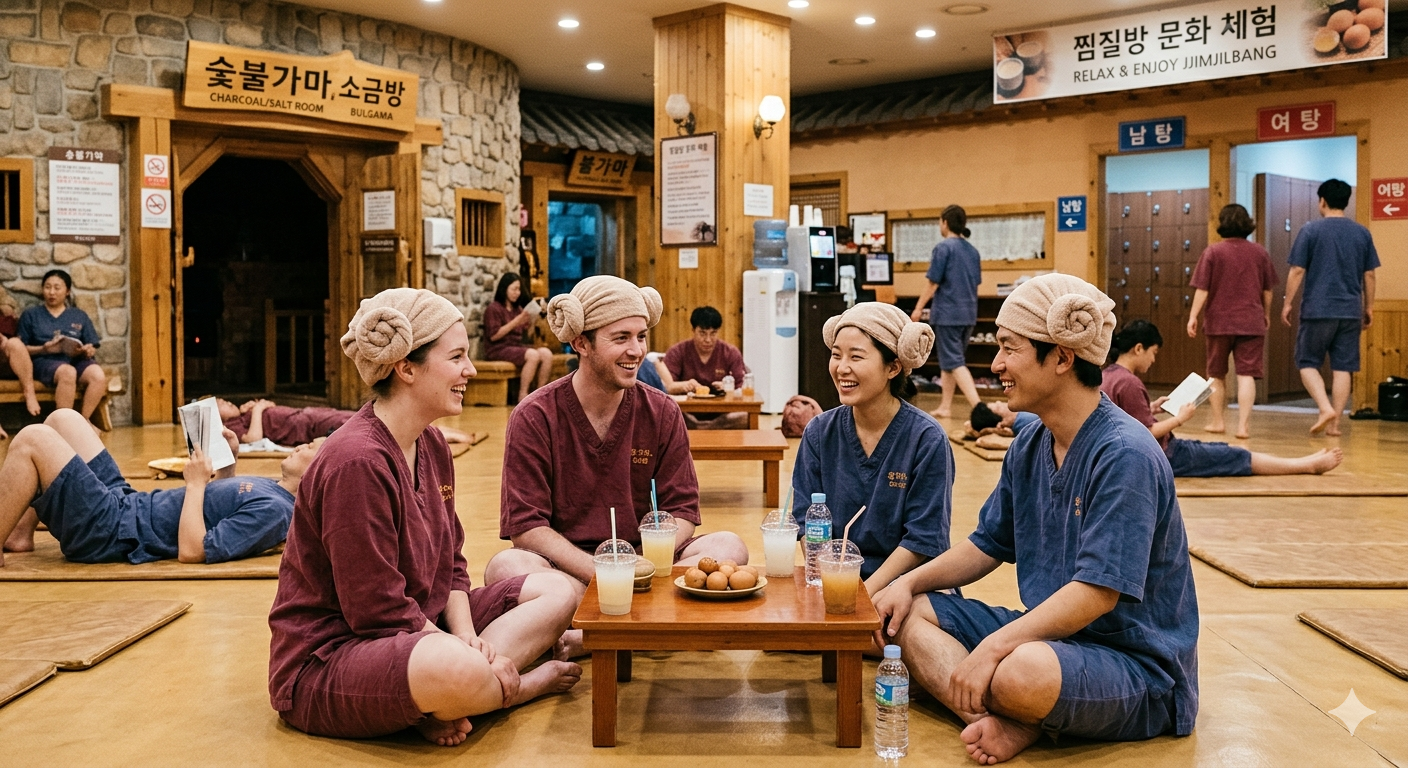
Step 7 — The jjimjilbang common area. After bathing, dry off, put on your jjimjilbok (the provided shorts and t-shirt), and move to the mixed-gender common area. This is the social heart of the facility.
| Area | Naked? | Gender | What Happens There |
|---|---|---|---|
| Shoe lockers | No | Mixed | Store shoes, receive key |
| Changing room / Locker | Yes (undressing) | Separated | Undress, store belongings |
| Mogyoktang (bathing) | Yes | Separated | Shower, pools, scrub |
| Common area / Jjimjilbang zone | No (jjimjilbok) | Mixed | Saunas, eating, sleeping |
| Snack bar | No (jjimjilbok) | Mixed | Eggs, sikhye, food |
The Naked Part: What Foreigners Are Actually Scared Of
Let me address this directly, because it’s the reason most foreign visitors hesitate. Yes, the bathing area requires complete nudity. No swimsuits, no shorts. And yes, you’ll be in an open communal space with other people of the same gender also completely naked. This is the part that creates cultural shock for visitors from Western countries where nudity is heavily sexualized.
Here’s what I can tell you from a lifetime of Korean experience: the bathing area of a jjimjilbang is genuinely one of the least sexualized environments you’ll ever be in. Nobody is looking at you. Nobody is commenting. Everyone is focused on their own washing, soaking, and scrubbing routines. The culture of the space is so thoroughly de-sexualized that foreign visitors consistently report that within about ten minutes, the nudity stops registering entirely. You will see grandmothers helping their granddaughters wash, mothers scrubbing their children, elderly women chatting over tubs, and teenagers quietly using their phones on the shower stools. It is, in the most literal sense, just people washing.
A few practical notes on what has changed in recent years. Tattoos, which were historically taboo in Korean bathing facilities, are now much more widely accepted. Most major jjimjilbangs in Seoul and tourist areas allow tattoos without restriction. Some older neighborhood facilities may still display “no tattoo” signs — when in doubt, call ahead. Also worth knowing: foreigners are not rare anymore at popular Seoul jjimjilbangs. Staff at Dragon Hill Spa, Siloam Spa, and similar facilities are entirely accustomed to international visitors and often have some English signage.
⚠️ Watch Out: Do NOT bring your phone or any electronic device into the naked bathing area. This is strictly enforced and considered a serious violation of privacy. Photography anywhere in the bathing rooms is illegal in Korea, not just against house rules. In the common area and snack bar, phones are fine.
The Best Jjimjilbang Experiences: Sauna Rooms, Eggs & Sikhye
The common area of a good jjimjilbang is full of things to do and eat that most foreign visitors have no idea about.
Themed sauna rooms (찜질 rooms): The common area typically has multiple small sauna rooms built from different materials, each with specific claimed health benefits. The charcoal room (숯불방) is the hottest and most detoxifying. The jade room is popular for far-infrared heat. The Himalayan salt room is lined with pink salt bricks. The ice room provides sharp contrast after the others — walking from a 90°C salt room into a 10°C ice room is a full sensory reset. You don’t need to stay long in any single room — 10–15 minutes is typical. The protocol is to lie or sit on the heated floor in your jjimjilbok, breathe slowly, and sweat. It’s meditative in a way that’s hard to replicate elsewhere.
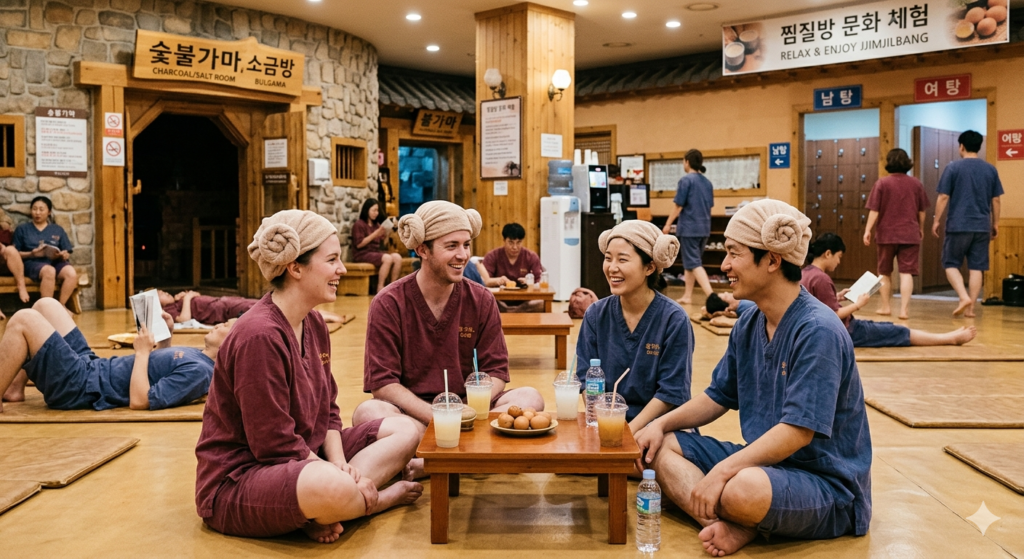
Maekbanseok gyeran (맥반석 계란) — sauna eggs: These are regular eggs cooked slowly in the heat of the kiln sauna rooms, and they are one of the most distinctive jjimjilbang foods. The slow heat turns the egg white a slight golden-brown and concentrates the flavor in a way that a boiled egg doesn’t achieve. They’re sold for ₩500–₩1,000 each at the snack bar. Every K-drama scene in a jjimjilbang features these eggs, and for good reason — they’re genuinely excellent. Sikhye (식혜) — sweet rice punch: A cold, lightly sweet traditional drink with floating rice grains at the bottom. It’s slightly fizzy, uniquely Korean in flavor, and pairs perfectly with the sauna eggs. The combination of a cold sikhye and a warm sauna egg while lying on a heated floor in the common area is arguably the most distinctly Korean sensory experience a visitor can have. Yangmori (양머리) towel style: The tradition of folding your jjimjilbang towel into a turban-like sheep’s head shape on top of your head. It’s visible in virtually every K-drama jjimjilbang scene. Do it. Take a photo. It’s required.
Best Jjimjilbangs in Seoul 2026 + Practical Tips
Dragon Hill Spa (용산): Seoul’s most famous and most internationally visited jjimjilbang. Multiple floors, outdoor pools, a restaurant, a variety of themed rooms, and very foreigner-friendly. Open 24 hours. Admission approximately ₩16,000 (weekday). Nearest subway: Noksapyeong Station (Line 6). This is where most first-time visitors go, and it earns the reputation. Siloam Spa (서울역): Located adjacent to Seoul Station, making it extremely convenient for early arrivals or late departures. Known for its outdoor rooftop spa experience. Admission approximately ₩13,000. Aquafield Hanam (하남): Larger and newer facility east of Seoul, popular with families and weekend visitors. Features a Himalayan salt room that’s particularly well-regarded. Slightly more expensive at approximately ₩20,000, but the facilities are exceptional. Accessible by bus from Gangdong or Hanam area.
A few final practical notes. Bring your own shampoo, conditioner, and body wash if you have preferences — the provided soap is basic. Bring a larger towel if you want more coverage in the changing area (the provided towels are small). Bring ₩5,000–₩20,000 in cash for snacks, scrub services, and any add-ons — your wristband covers inside purchases but you’ll want cash for incidentals. Most importantly: plan to stay longer than you think you need. The jjimjilbang works best at a slow pace. Two to three hours is a comfortable visit. Four hours feels like a full day off. And if you stay overnight — which costs nothing extra if you arrived before midnight — you’ll wake up having slept on a heated floor in the warmest room you’ve ever encountered, and that is an experience genuinely unlike anything else in the world.
Frequently Asked Questions
Do I have to be naked at a Korean jjimjilbang?
Nudity is required only in the gender-separated bathing area (mogyoktang). The rest of the jjimjilbang — including all sauna rooms, the common sleeping area, and the snack bar — is co-ed, and everyone wears the provided shorts and t-shirt uniform. You are never naked in a mixed-gender setting. Most visitors find the bathing area far less intimidating once they’re inside, as the culture is entirely non-sexual and focused on hygiene and relaxation.
How much does a Korean jjimjilbang cost in 2026?
Entry fees range from ₩7,000 at small neighborhood mogyoktang to ₩20,000 at major facilities like Dragon Hill Spa or Aquafield. Most popular Seoul jjimjilbangs charge ₩12,000–₩16,000 on weekdays. This includes unlimited time, a locker, provided uniform, and towels. Overnight stays are typically the same price — just stay until morning. Additional services like professional body scrubs cost ₩15,000–₩25,000 extra and are optional.
Are tattoos allowed in Korean jjimjilbangs?
Most major jjimjilbangs in Seoul and tourist areas are now tattoo-friendly. Attitudes have shifted significantly in recent years. Dragon Hill Spa and Siloam Spa both accept tattooed visitors. Some older neighborhood mogyoktang may still have no-tattoo policies — check their websites or call ahead. If you have visible tattoos and are unsure, contact the specific facility directly before visiting.
What should I eat at a jjimjilbang?
The essential jjimjilbang snacks are maekbanseok gyeran (sauna-roasted eggs, ₩500–₩1,000 each) and sikhye (sweet rice drink, ₩1,500–₩2,000). The combination of a warm sauna egg and a cold sikhye is deeply Korean and genuinely delicious. Larger facilities also have proper restaurants serving Korean meals. Eating in the common area while lying on a heated floor in your provided uniform is considered completely normal.
Final Thoughts from a Korean Local
I took a British colleague to Dragon Hill Spa on his third visit to Korea — he’d been twice before and never gone. We stayed four hours. He got the seshin body scrub, ate three sauna eggs, had two cups of sikhye, and fell asleep for forty minutes on a heated floor in the salt sauna room. On the subway back to his hotel, he said the same thing almost every foreigner says: “I can’t believe I waited this long.” The jjimjilbang isn’t exciting in the way that palaces or K-pop concert venues are exciting. It’s a slower, more physical, more genuinely restorative kind of experience. And it’s utterly, specifically Korean in a way that few other things are. Please go. Drop your questions in the comments — I’m happy to help you pick the right one for your visit.
📚 You might also like:

For up-to-date operating hours and admission prices, visit Dragon Hill Spa’s official website before your visit.
