
Korean Drinking Culture 2026: An Honest Guide to Soju & Chimaek
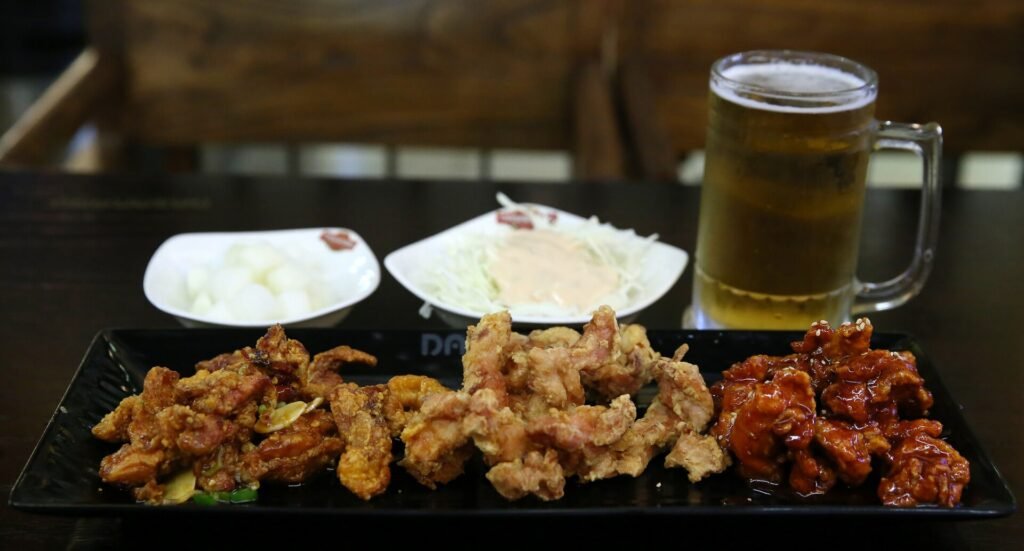
Photo: Iksan City 48 Korean Style Fried chicken by KOREA.NET, CC BY-SA 2.0, via Wikimedia Commons
Korea ranks among the world’s highest countries for alcohol consumption per capita. But the thing nobody tells you is that Korean drinking culture isn’t really about the alcohol — it’s about connection. And there’s an entire set of unspoken rules you need to know.
I grew up watching my father navigate hoesik (after-work drinking) with the precision of a diplomat. As a Korean working in the chemical industry for over 13 years, I’ve sat through hundreds of Korean drinking sessions — company dinners where soju flowed with military precision, late-night pojangmacha visits where strangers became friends over fish cake skewers, and lazy Saturday afternoons with chimaek (fried chicken and beer) on the Han River. Korean drinking culture is one of the most misunderstood aspects of Korea for foreign visitors: they either expect everyone to be drinking constantly, or they worry they’ll offend someone by not drinking. The reality is more nuanced and much more interesting. Here’s how it actually works.
📋 Quick Navigation
- The 3 Drinks You Need to Know: Soju, Makgeolli & Beer
- Korean Drinking Etiquette: 7 Rules That Actually Matter
- The Multi-Round System: How a Korean Night Out Actually Works
- Chimaek, Somaek & Pojangmacha: The Holy Trinity
- What to Do If You Don’t Drink — And the Morning After
The 3 Drinks You Need to Know: Soju, Makgeolli & Beer
The first time I taught a foreign colleague the proper soju pour — two hands, label forward, wait for the senior to drink first — he spent the rest of the evening practicing on everyone. His Korean team noticed.
Soju (소주): Korea’s national spirit and the world’s best-selling liquor by volume. Clear, slightly sweet, around 16–17% ABV in most modern versions. Jinro and Chamisul are the dominant brands — you’ll see the green bottles everywhere. Soju is drunk in shots, not sipped. A bottle costs around ₩2,000 at a convenience store and roughly ₩5,000–₩7,000 at a restaurant or bar in Seoul. It’s smooth enough to drink straight but mixes extremely well with beer (somaek) or various fruit flavors. Modern flavored variants — strawberry, grapefruit, peach — are popular with younger drinkers and significantly more accessible for foreign palates. Makgeolli (막걸리): Traditional Korean rice wine.
Milky white, slightly fizzy, low-alcohol at around 6–8% ABV, with a gentle sweet-sour flavor that’s unlike anything in Western drinking culture. Served cold in a large bowl shared at the table, or in smaller individual cups. Pairs exceptionally well with Korean pancakes (pajeon).
Makgeolli is currently experiencing a global renaissance — it’s now available in specialty bars in New York, London, and Tokyo — but drinking it fresh from a Korean farmer’s market or traditional restaurant is on a completely different level. Maekju (맥주, beer): Hite, OB, and Cass are the main domestic lagers. Clean, light, inoffensive. Korea’s craft beer scene has grown significantly in the past decade — neighborhoods like Itaewon, Hongdae, and Seongsu-dong now have excellent craft beer bars. Beer is the foundation of chimaek and the base for somaek.
💡 A Tip From a Local: At company dinners and any setting with a senior Korean present, start with soju. It’s the expected first-round drink. Switching to beer too early can read as an attempt to drink less, which has social implications. Once the soju bottles are empty and everyone’s relaxed, the evening usually moves toward beer or mixed drinks naturally. Ordering makgeolli at a Korean BBQ restaurant is always well-received regardless of seniority — it’s nostalgic and broadly liked.
Korean Drinking Etiquette: 7 Rules That Actually Matter
Korean drinking etiquette has deep roots in Confucian social hierarchy, and while younger Koreans have relaxed many of the older rules, some still carry genuine social weight. Breaking these in the wrong context isn’t a catastrophe — Koreans are genuinely understanding with foreigners who make an effort — but knowing them marks you as someone who respects the culture.
Rule 1 — Never pour your own drink. In Korean drinking culture, you pour for others, and others pour for you. Pouring your own glass signals either that you’re in a hurry to drink (which reads as impolite) or that you’re isolated from the social group. Watch your neighbors’ glasses and refill when empty. They’ll do the same for you.
Rule 2 — Use both hands when receiving a pour. Hold your glass with both hands, or place your free hand on your forearm while receiving. This applies especially when a senior person is pouring for you. It’s a gesture of respect that Koreans notice and genuinely appreciate.
Rule 3 — Turn your head away when drinking in front of elders. When taking a shot in the presence of someone significantly older or more senior, turn your head slightly to the side. This isn’t hiding the drinking — it’s a formalized gesture of modesty.
It’s the most distinctly Korean of all the rules and the one that most impresses Korean hosts when a foreigner gets it right. Rule 4 — Say “Geonbae” before the first drink. This means cheers. Make eye contact as you say it. Clink glasses. Drink. Rule 5 — Don’t leave before the senior person. In a formal setting, the oldest or most senior person at the table sets the pace and the ending. Leaving early without good reason can read as disrespectful. Rule 6 — Eat your anju.
Anju (안주) is the food eaten alongside alcohol. In Korean culture, drinking without anju is considered bad form — it signals that you’re drinking purely to get drunk rather than to enjoy a social experience. Order something. Rule 7 — Don’t pressure people to drink. The old “one shot” culture of obligatory drinking is fading, especially among younger Koreans. Many are cutting back or going fully sober. Nobody will judge you for declining — see the last section for how to handle this gracefully.
| Rule | What It Means | Importance |
|---|---|---|
| Both hands when receiving | Gesture of respect for elder/senior pourer | ⭐⭐⭐⭐⭐ High |
| Never pour your own | Watch neighbors, refill proactively | ⭐⭐⭐⭐⭐ High |
| Turn head when drinking | Modesty gesture with elders present | ⭐⭐⭐⭐ Medium-High |
| Geonbae before first drink | Eye contact, clink, drink together | ⭐⭐⭐⭐ Medium-High |
| Order anju | Food alongside alcohol, never drink alone | ⭐⭐⭐⭐ Medium-High |
| Don’t leave before senior | Formal settings only; less relevant casually | ⭐⭐⭐ Medium |
The Multi-Round System: How a Korean Night Out Actually Works
A Korean evening out follows a multi-round structure called “cha” (차), and understanding this is essential for navigating any social drinking situation. The night is structured in acts, each at a different venue, each with a slightly different character.
1차 (Il-cha, First Round): Dinner with alcohol. Korean BBQ is the most popular setting — samgyeopsal (pork belly), galbi (short ribs), or bulgogi with plenty of soju and maekju flowing alongside. This is the most formal part of the evening if you’re with colleagues. The food is central, the conversation is warm, and the first bottles of soju are opened. 2차 (I-cha, Second Round): The group moves to a bar or pojangmacha for the second phase. This is where the social loosening really happens. Rank matters less, conversation gets more personal, and makgeolli or somaek might replace straight soju. 3차 (Sam-cha, Third Round): Noraebang (karaoke) is the classic Korean third round.
Private rooms rented by the hour, microphones in everyone’s hands, the full song catalog of Korean and international pop. The quality of your singing is irrelevant — the point is participation. For foreign visitors, this is often the highlight of the entire evening. 4차 (Sa-cha, Fourth Round): If the group is still together and still energized, the fourth round might be a pojangmacha for anju and final drinks before dispersing. Not everyone makes it to 4차, and nobody judges those who head home after 1 or 2 rounds.
Chimaek, Somaek & Pojangmacha: The Holy Trinity
Chimaek (치맥) — Fried Chicken + Beer: This is possibly the most beloved casual Korean meal-and-drink combination. Crispy Korean fried chicken — double-fried, dramatically crunchier than anything in Western fast food — paired with cold beer. The combination took on international fame through the K-drama “My Love from the Star” (별에서 온 그대), but Koreans have been doing it long before that. Chimaek on a summer evening at a Han River park, watching the sunset with cold cans of Hite and a box of garlic soy chicken, is a genuinely simple joy. Somaek (소맥) — Soju + Beer: The signature Korean bomb drink. The optimal ratio is 3:7 (soju to beer). Pour soju into beer, stir gently with chopsticks, drink as a shot.
The beer dilutes the soju’s edge while the soju gives the beer a kick. It goes down dangerously smoothly and is responsible for more than a few legendary evenings in Korean history. Pojangmacha (포장마차): The orange-tarped street tent that appears in virtually every K-drama involving rain, heartbreak, or celebration. These open-air street stalls serve soju, beer, and anju — fish cake skewers (odeng), tteokbokki, spicy stir-fried gizzards, grilled squid — on plastic stools and fold-up tables. They appear at dusk in neighborhoods throughout Seoul and are typically cash-only. The best concentrations are in Euljiro 3-ga, Jongno 3-ga, and along the Han River in spring and summer. Budget ₩20,000–₩35,000 per person for drinks and anju.
What to Do If You Don’t Drink — And the Morning After
This is one of the most important things I can tell foreign visitors about Korean drinking culture in 2026: not drinking is entirely acceptable. Korea’s relationship with alcohol is changing. A significant portion of younger Koreans (particularly the MZ generation) are cutting back dramatically, going sober, or choosing not to drink for health or personal reasons. Pojangmacha tents now commonly serve non-alcoholic beer, sparkling teas, and sodas. It’s perfectly fine to raise a glass of Chilsung Cider (Korea’s lemon-lime soda) for geonbae and participate fully in the social ritual without consuming alcohol. If asked why you’re not drinking, a simple “건강 때문에” (geongang ttaemuneyo, “for health reasons”) is universally accepted without further questioning.
If you did drink — particularly if somaek was involved — Korean morning-after culture is equally thoughtful. Haejangguk (해장국, hangover soup) is an entire category of Korean cuisine dedicated to post-drinking recovery. The most famous version is a rich beef bone broth with dried napa cabbage and congealed ox blood. Cheongjinok (청진옥) near Jonggak, serving haejangguk since 1937, is Seoul’s most storied place for this.
If a bowl of ox blood soup sounds too ambitious for 8 AM, every convenience store carries Condition, Morning Care, and other hangover drinks at ₩2,500–₩4,000 that Koreans swear by. And of course: Shin Ramyun from the convenience store microwave, eaten at the standing counter at 7 AM, is also a completely valid Korean hangover response and requires no further justification.
Quick Answers
What is the most important rule of Korean drinking etiquette for foreigners?
The two rules that Koreans notice most immediately are: always use both hands when receiving a drink poured by someone else (especially an elder or senior), and never pour your own glass — pour for others and let them pour for you. These two gestures signal that you understand and respect the social protocol, and Koreans are genuinely appreciative when foreign guests get them right. Everything else is secondary.
What is somaek and how do you make it?
Somaek is a mixture of soju and beer — Korea’s signature bomb drink. The optimal ratio is 3 parts soju to 7 parts beer. Pour soju directly into a glass of beer and stir gently with chopsticks. Drink it as a shot. The beer smooths the soju’s edge while the soju gives the beer body and kick. The result tastes deceptively mild and goes down faster than either drink would alone. Handle accordingly.
What is a pojangmacha and where can I find one in Seoul?
A pojangmacha (포장마차) is an informal Korean street tent bar — an orange-tarped stall with plastic stools, fold-up tables, and a menu of soju, beer, and anju snacks. They appear in the evenings and are a quintessentially Korean social experience. The best concentrations in Seoul are around Euljiro 3-ga, Jongno 3-ga, and Namdaemun. Along the Han River (Yeouido area), seasonal pojangmacha operate in spring and summer evenings. Most are cash-only. Budget ₩20,000–₩35,000 per person for drinks and food.
Is it okay not to drink alcohol in Korean drinking culture?
Yes, completely. Korean drinking culture has changed significantly among younger generations, and not drinking is well-accepted. Simply say “건강 때문에 안 마셔요” (I don’t drink for health reasons) — this is respected without question. Raise a glass of Chilsung Cider or non-alcoholic beer for the geonbae toast and participate fully in the social ritual. No Korean host will pressure you, and the food (anju) is excellent whether you’re drinking or not.
The Bottom Line
Korean drinking culture at its best is one of the most genuinely social experiences I know. The rules exist not to exclude people but to create a shared language of respect and care — when you pour for someone else before yourself, you’re saying something about how you see the relationship. When you turn your head slightly before drinking in front of an elder, you’re acknowledging that the hierarchy between you means something.
These small gestures add up to evenings that feel distinctly different from bar culture in most Western countries — warmer, more reciprocal, more attentive to the people around you. You don’t need to drink to appreciate this. You just need to pay attention. If you’re planning a trip to Korea, let yourself have at least one evening that runs through all the rounds — dinner, second venue, noraebang. You don’t have to drink everything poured for you. But stay through the whole arc. That’s where the real Korea is. Drop a comment below with your questions or your own Korean drinking stories.
📚 You might also like:
- How to Use a Korean Jjimjilbang in 2026: Full Foreigner’s Guide
- Korean Age System Explained
- Korean Etiquette: Essential 2026 Tips for Foreigners
For more on Korean food and drink culture, Visit Korea’s official English portal has current information on cultural experiences and food tourism programs.
